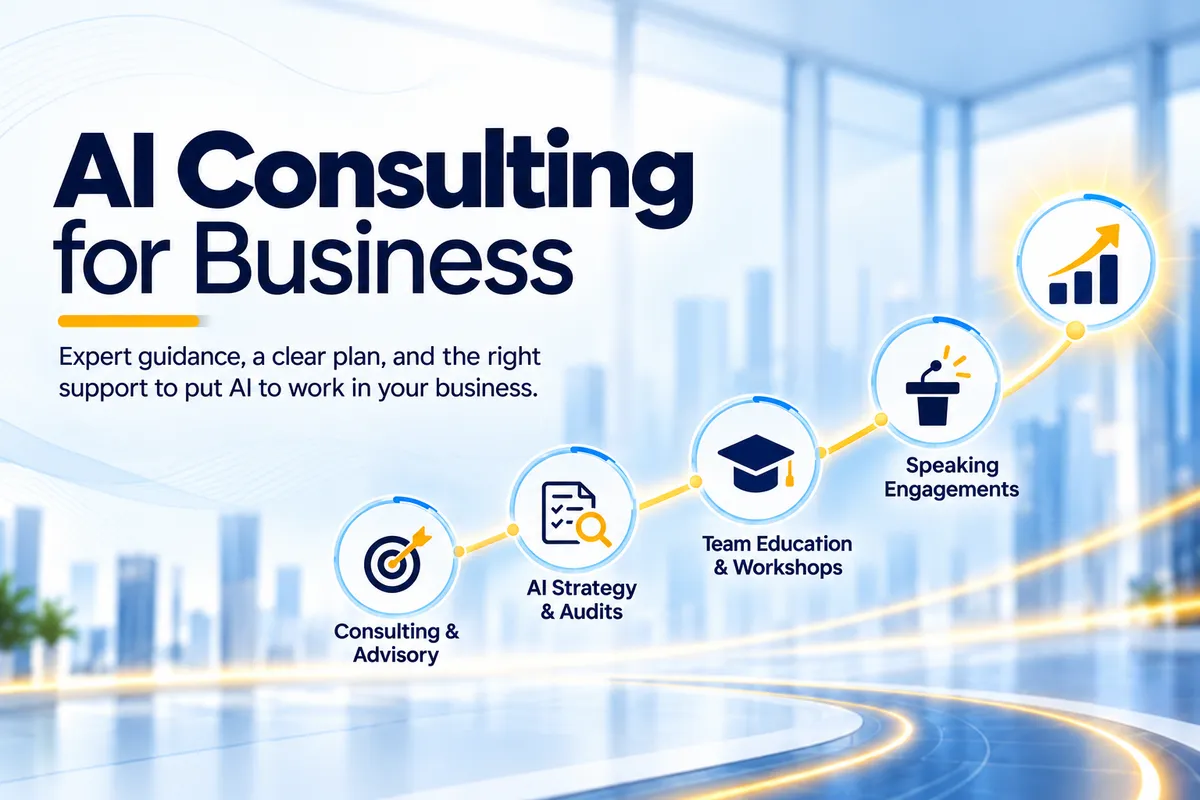
AI Consulting for Business: How Creator Digital Media Helps You Get Started
Artificial intelligence is no longer limited to technical teams. Business owners, executives, and department leaders are being asked to decide where AI fits, which tools are appropriate, how employees should use them, and what investment makes sense.
Those decisions are harder than they first appear. A new tool may look useful in a demonstration but require changes to workflows, data access, staff responsibilities, or existing systems before it can deliver consistent results.
AI consulting helps businesses work through those decisions. Creator Digital Media (CDM) provides AI consulting, strategy, automation, and support services to help organizations evaluate opportunities, plan improvements, and put AI to work in ways that fit their operations.
What does AI consulting for business involve?
AI consulting is professional guidance on how an organization can evaluate, adopt, and manage AI. It can begin with a leadership conversation about business priorities, a review of existing processes, or an assessment of how prepared the organization is to introduce new tools.
The work depends on the organization. A small business may need help identifying one high-value use case. A mid-sized company may need to coordinate decisions across departments. An enterprise team may need a structured approach to ownership, systems integration, security review, and oversight.
An effective engagement should produce clear decisions: what problem to address, what is needed to proceed, who will be responsible, and how results will be evaluated.
Where CDM can help AI consulting and advisory
Some businesses are still determining where AI belongs. Others already use several tools but have no shared plan. Consulting and advisory discussions can help leadership identify business priorities, consider options, and determine where further assessment or implementation work is warranted.
This may involve reviewing opportunities to improve customer communication, internal operations, employee productivity, knowledge access, or reporting. The objective is not to recommend AI for every process. It is to identify where a change could address a meaningful business need.
AI audit and strategy
An AI audit or strategy engagement examines the business environment before major decisions are made. That can include current workflows, existing software, staff responsibilities, available information, and operational constraints.
From that review, a business can establish priorities and an implementation sequence. For example, a company may decide that improving lead response should come before purchasing additional marketing tools, because delayed follow-up is the problem it can already measure.
AI systems setup and automation
Planning is only useful when a business can execute it. CDM also provides AI systems setup and automation services, which may involve connecting business tools, improving information flow, introducing AI-assisted processes, and configuring workflows around defined operating needs.
A business might improve how inquiries enter its CRM, how appointments are handled, or how routine information is routed to employees. Each implementation should account for exceptions, human review, and the information the system is permitted to use.
AI support and ongoing improvement
Business processes change. Staff adopt tools at different rates, and software capabilities evolve. Ongoing support can help an organization review performance, address operational issues, adjust workflows, and determine when another improvement is justified.
Support should also help make responsibilities clear. Employees need to know when they can rely on an AI-assisted process, when they should check its output, and whom to contact when something does not work as expected.
People are part of the decision
AI adoption is not only a systems project. Employees may need guidance on approved use cases, information handling, quality checks, and changes to their daily work. Leaders may need a shared understanding of what AI can do, where it is unreliable, and how to evaluate investment proposals.
Depending on business needs, CDM can discuss leadership advisory, custom team education, facilitated workshops, and speaking engagements. Any specific format and scope would be defined through a consultation.
When should a business seek AI consulting?
There is no requirement to wait until an organization has a large AI budget. Outside guidance can be useful when leaders face a decision they cannot resolve confidently with existing resources.
• Different teams are testing AI tools without common policies or clear ownership.
• Leaders want to include AI in the next annual plan but cannot yet identify credible priorities.
• A workflow has recurring delays or manual work, but the right solution is unclear.
• The company is evaluating AI vendors or implementation proposals and needs a way to compare them.
• Employees need consistent guidance before AI becomes part of daily work.
• An existing AI-enabled workflow needs review because results, oversight, or adoption are inconsistent.
A consulting conversation can also conclude that an organization should improve its processes, documentation, or data quality before introducing more AI. That can be a valuable decision in itself.
What should businesses prepare before the first conversation?
Businesses can make an initial discussion more useful by bringing a short description of the problems they want to solve, the systems they already use, and the people who own the work today.
• One or two business outcomes worth improving, such as response time, processing time, error rates, or customer experience.
• A simple description of the current workflow and where work gets delayed or repeated.
• Known constraints, including budget, staff capacity, data sensitivity, and deadlines.
• An internal decision-maker and the people who understand the process being evaluated.
Not every answer needs to be available in advance. The point is to begin with business context, rather than an unranked list of products to buy.
Plan for 2027 with clear priorities
For businesses preparing 2027 budgets, the most useful first step is to separate discovery and planning from implementation. A budget can account for assessing needs, preparing employees, configuring systems, and maintaining what is deployed. These activities have different costs and should not be treated as one undefined AI expense.
CDM works with businesses at different stages, from initial questions about where to begin to more developed needs involving strategy, systems, and support. A well-scoped consulting engagement gives the organization a clearer basis for deciding what belongs in its plan and what should wait.
If your organization is reviewing AI opportunities, preparing its 2027 plans, or determining what support it needs, request a consultation with Creator Digital Media. We can discuss your business priorities, current systems, and the next decisions your team needs to make.
Frequently Asked Questions
What does an AI consultant do for a business?
An AI consultant helps a business assess opportunities, set priorities, consider risks, plan changes, and determine the people, processes, and systems needed for adoption.
Do we need to know which AI tools we want before consulting?
No. Start with the business problem, the existing workflow, and the result you need. Product selection should follow a clearer understanding of requirements.
Can AI consulting help a small business?
Yes. An initial engagement can focus on one defined issue, such as missed inquiries or repetitive administrative work, rather than a company-wide transformation.
Does AI consulting always lead to an implementation project?
No. An assessment may show that a process change, clearer documentation, or better data quality should come first.