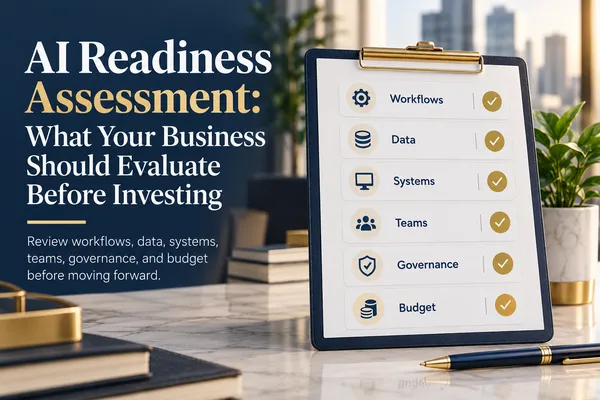
AI Readiness Assessment: What Your Business Should Evaluate Before Investing
Many businesses begin exploring AI by looking at software demonstrations or asking employees which tools they want to use. That can generate ideas, but it does not show whether the organization is prepared to use those tools responsibly or achieve a worthwhile result.
An AI readiness assessment helps business leaders examine the conditions needed for an investment to work. It looks at the business problem, the existing workflow, the information available, the systems involved, employee responsibilities, and the safeguards required. The objective is not to prove that every department is ready. It is to identify what needs attention before the business commits money and staff time.
Start with a business decision, not an AI product
Define the result you want to improve. It might be reducing delays in handling customer inquiries, making internal knowledge easier to find, improving order accuracy, or helping employees complete repetitive administrative work. Choose a process with a responsible owner and a result you can observe.
Write down the current condition, the cost or consequence of the problem, and what would count as improvement. If the goal is faster inquiry handling, establish current response times and identify where inquiries are lost or reassigned. That gives the readiness review a specific purpose.
Without a defined outcome, a readiness assessment can become a broad discussion about technology instead of a decision about the business.
1. Are your workflows clear enough to evaluate?
AI should not be introduced into a process that nobody can explain or consistently follow. Review how work enters the business, who takes the next action, what exceptions occur, and how the work is completed. Pay attention to informal handoffs and steps that live only in an experienced employee’s memory.
For the process under consideration, ask whether employees follow the same sequence, whether approvals are documented, and whether exceptions can be routed to the right person. If the process is inconsistent, simplify or document it before evaluating automation.
2. Is your business information usable and reliable?
AI-enabled workflows need appropriate information. Depending on the use case, that may include customer records, service descriptions, policies, order details, knowledge-base content, or historical workflow data. Poorly maintained information can produce incorrect outputs even when the technology itself functions as intended.
Check whether records are accurate, current, complete, accessible to authorized staff, and organized in a form that supports the proposed use. Identify information that cannot be shared with an AI system without additional controls. Assign an owner to correct gaps, remove duplicates, and maintain source material.
Do not assume a large collection of documents is a usable knowledge base. Information still needs structure, access rules, and a review process.
3. Can your current systems support the proposed use?
List the applications that the workflow depends on, such as the website, CRM, scheduling system, customer service platform, document repository, or accounting software. Determine which systems contain the authoritative record and whether the information can move between them reliably.
Ask who has access to integrations, whether approved connection methods are available, what errors are logged, and how the process continues when a system is unavailable. A workflow that depends on manually transferring information between disconnected systems may need process or integration work before AI adds value.
4. Do employees know their responsibilities?
Business readiness includes employees and managers, not just technology. Identify who will use the new capability, what tasks it may support, what employees must still decide, and who can stop or override its output.
A team may be comfortable experimenting with general AI tools but still lack the training to apply AI to customer information or operational decisions. Different roles need different levels of guidance. Supervisors may need to review exceptions and performance; staff may need instructions for approved use, privacy limits, and escalation.
Ask what each affected role must learn before launch and how the organization will confirm the training was understood. Do not confuse attending a session with being ready to perform the work.
5. Are security, privacy, and approval rules defined?
Before providing an AI tool access to business information or allowing it to generate customer-facing actions, determine what information it may receive, what it may produce, and what requires human approval. Review security and privacy requirements with the people responsible for those obligations.
Document access permissions, prohibited uses, monitoring expectations, error handling, and escalation. The level of review should reflect the impact of a mistake. Drafting an internal summary does not carry the same consequences as changing an account record or sending a customer a financial commitment.
6. Who owns the investment after launch?
Every proposed AI initiative needs an accountable business owner. That person should coordinate decisions, confirm that staff can work with the new process, review results, and direct corrections when the system does not perform as expected.
Readiness also requires a budget for more than the initial consulting or software expense. Plan for testing, employee time, integration, usage charges, ongoing information maintenance, and support. If these costs and responsibilities have no owner, the business may not be ready to proceed.
Use a readiness worksheet before approving spending
A simple worksheet can make gaps visible without pretending that readiness is one universal score. For each area, record the current condition, the evidence available, the responsible owner, the gap to resolve, and the next decision.
Review area | Evidence business leaders should request |
Business objective | Defined problem, process owner, baseline, and expected improvement |
Workflows | Current process map, exceptions, handoffs, and approval points |
Data and knowledge | Verified source records, quality issues, access restrictions, maintenance owner |
Systems and integrations | Current tools, system-of-record decision, integration constraints, recovery path |
Workforce | Affected roles, training requirements, human review and escalation responsibilities |
Governance | Privacy and security rules, allowed uses, permissions, approval requirements |
Investment ownership | Sponsor, project owner, budget assumptions, support and review cadence |
Mark each area as ready to proceed, needs corrective work, or not yet determined. These are planning judgments, not a certification or industry-standard readiness rating. Record the basis for each judgment and revisit it as conditions change.
Decide whether to proceed, prepare, or pause
An assessment is valuable only when it informs a decision. The business might proceed with a limited, supervised test if a specific use case is well understood and the necessary information, permissions, and ownership are in place. It might first repair inconsistent records or document a workflow. It may also pause an idea whose business benefit is unclear or whose risks cannot yet be controlled.
Avoid interpreting “not ready” as a failure. It simply identifies work that must happen before additional spending makes sense. A smaller first project can often provide better evidence than attempting a company-wide rollout without the right foundations.
Business example: preparing an AI-assisted inquiry process
Consider a service business that wants AI assistance with sorting website inquiries and preparing follow-up tasks. A readiness review reveals that the company receives inquiries through three channels, uses different lead categories across teams, and has no documented procedure for urgent requests.
The immediate priorities are to define lead categories, assign response ownership, confirm consent and information handling rules, and establish what must be escalated. The business can then evaluate a limited AI-assisted workflow and decide whether broader implementation is justified.
This is an illustrative scenario, not a claim about a CDM client or a guaranteed outcome.
Questions business owners should ask before investing
· What business problem are we trying to solve, and what evidence shows it matters?
· Can employees explain and follow the existing process consistently?
· Are the records and policies the system would use accurate and approved?
· Do our current systems support the proposed workflow and recovery process?
· Who must review or approve sensitive outputs and decisions?
· What training will each affected employee or manager require?
· Who owns ongoing performance, exceptions, costs, and improvements?
· What would cause us to proceed, revise the approach, or stop?
Assess readiness before expanding your AI investment
A sound AI investment begins with a business problem and a clear understanding of the conditions needed to address it. Readiness work helps leadership identify gaps early, establish ownership, and avoid approving software or implementation work that the organization cannot yet support.
Creator Digital Media helps businesses review their AI opportunities, assess operating requirements, clarify priorities, and determine where advisory or implementation assistance may be appropriate. Start with the decision your business needs to make, then identify what must be ready for that decision to succeed.
Frequently Asked Questions
What is an AI readiness assessment for a business?
It is a review of the objectives, processes, information, systems, people, safeguards, and ownership needed to support a proposed AI use case. It helps business leaders decide what to prepare before making larger commitments.
Is an AI readiness assessment the same as an AI audit?
They can overlap, but they answer different questions. A readiness assessment focuses on whether the business is prepared for a particular investment. An AI audit may examine existing AI tools, workflows, risks, or performance. The exact scope should be defined before the work begins.
Does a business need to be ready in every department before using AI?
No. A limited use case can be appropriate when its requirements, risks, responsibilities, and measures are understood. Company-wide readiness is not a prerequisite for every controlled project.
What should a business do if the readiness assessment identifies gaps?
Assign owners, prioritize the gaps that affect the proposed use case, document necessary changes, and decide when to reassess. Some initiatives should be narrowed or delayed until the required controls and information are in place.