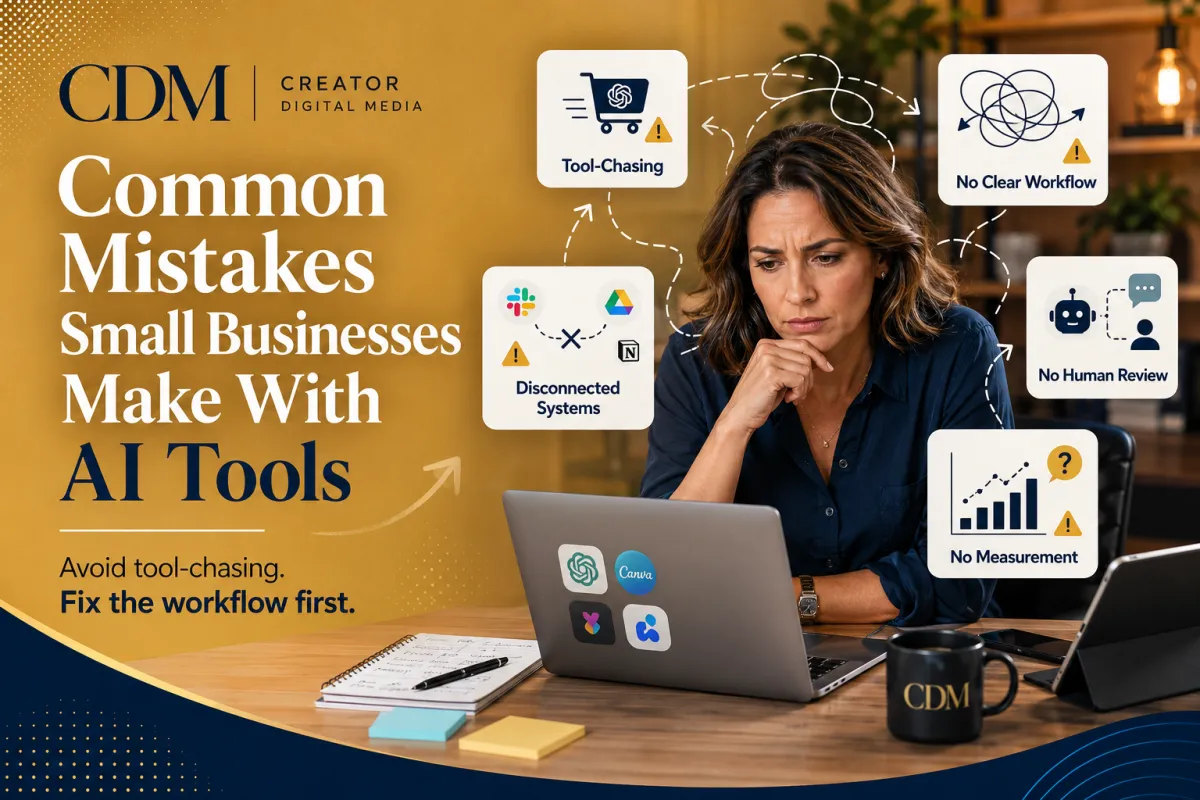
Common Mistakes Small Businesses Make With AI Tools
AI tools are easier to access than ever, but easier access does not automatically create better business results.
Many small businesses are experimenting with AI tools, but the results are often inconsistent. One tool writes content. Another summarizes calls. Another creates images. Another answers questions. Another connects to the CRM. After a while, the business has more accounts, more options, and more confusion.
The problem is usually not that the tools are bad. The problem is that the business has not decided how the tools should support real operations.
For small businesses, AI tool adoption should be disciplined, measured, and tied to a workflow. Otherwise, it can turn into tool-chasing instead of business improvement.
Mistake 1: Starting with the tool instead of the business problem
The most common mistake is starting with the question, "Which AI tool should we use?"
That question can be useful later, but it is not the best starting point. A better first question is: "What business problem are we trying to solve?"
The problem may be slow lead follow-up, missed calls, manual reporting, repetitive customer questions, inconsistent content production, or too many admin tasks falling back on the owner.
When the business problem is clear, tool selection becomes easier. When the problem is unclear, every tool looks interesting and none of them become operationally useful.
Mistake 2: Testing too many tools at once
AI tool sprawl happens quickly. A business may test one tool for writing, one for design, one for meetings, one for automation, one for chat, and one for reporting. Each tool may be useful on its own, but the total system becomes harder to manage.
Too many tools create operational problems:
· Duplicate accounts
· Scattered information
· Unclear ownership
· Inconsistent outputs
· Weak adoption
· More subscriptions to monitor
· More places for work to disappear
A small business does not need to avoid testing tools, but it should avoid testing without discipline. Limit the number of active experiments and decide what each tool is supposed to prove.
Mistake 3: Automating a workflow that is not clear yet
Automation makes a defined process faster. It does not fix an undefined process.
If the current workflow is unclear, AI automation may only move confusion faster through the business. For example, if no one knows what should happen after a new lead comes in, automating lead messages will not solve the real issue. The business first needs to define the lead handling process.
Before using an AI tool in a workflow, the business should know:
· What triggers the workflow
· What information is needed
· What output should be created
· Who reviews the output
· What happens next
· How errors will be handled
The rule is simple: do not automate confusion.
Mistake 4: No clear owner
AI tools need ownership. Someone has to decide how the tool is used, review whether it is working, update the workflow, and decide when to stop using it.
Without an owner, tools get added but not managed. People may use them differently. Outputs may vary. No one knows whether the tool is saving time, improving quality, or creating risk.
A small business does not need a large AI governance committee. It does need a clear owner for each tool or workflow.
Ownership answers three questions:
· Who is responsible for the tool?
· Who reviews the output?
· Who decides whether the tool stays, changes, or gets removed?
Mistake 5: Using AI outputs without review
AI tools can produce useful drafts, summaries, ideas, and recommendations. But small businesses should be careful about using outputs without review, especially when the output affects customers, pricing, legal language, financial decisions, health or safety, or brand reputation.
Human review does not have to slow everything down. It should be applied where the stakes are higher. For lower-risk internal tasks, review may be lighter. For customer-facing or decision-sensitive tasks, review should be more deliberate.
The goal is not to distrust every output. The goal is to know where review is required.
Mistake 6: Not measuring whether the tool helped
A tool can feel useful without improving the business. That is why measurement matters.
For small businesses, the first metrics do not need to be complicated. Useful measures include:
· Time saved each week
· Faster lead response
· Fewer missed follow-ups
· Fewer manual steps
· Better customer response quality
· More consistent content production
· Fewer errors or handoff gaps
· Less owner involvement in repetitive tasks
If a tool does not improve a repeated workflow, save time, increase clarity, or support better customer experience, it may not be worth keeping.
Mistake 7: Confusing experimentation with implementation
Experimentation is useful. Implementation is different.
Testing a tool for a few days is not the same as building it into the business. Implementation requires a defined use case, a workflow, ownership, review rules, and a way to measure results.
A business can experiment to learn what is possible. But once a tool touches real operations, the standard should be higher.
Mistake 8: Ignoring customer experience
Some AI tools improve internal efficiency but create a worse customer experience if they are used carelessly. A chatbot that gives vague answers, a voice assistant with poor handoff rules, or an automated email that feels disconnected can create frustration instead of trust.
Before using AI in customer-facing workflows, small businesses should ask:
· Will this make the customer experience faster or clearer?
· Does the customer know what to do next?
· Is there an easy human handoff?
· Are the answers accurate enough?
· Does this match the brand and service standard?
AI should support customer experience, not weaken it.
Mistake 9: Treating AI as a separate side project
AI tools should not live completely outside the business operating system. If a tool is useful, it should connect to how the business already manages leads, customers, tasks, reporting, content, or delivery.
This does not mean every tool needs deep technical integration immediately. It means the business should know where the tool fits.
The most useful AI tools become part of a workflow. The least useful ones stay as disconnected experiments.
A better way to adopt AI tools
A practical AI tool adoption process can be simple:
· Start with one business problem
· Choose one workflow
· Select one tool to test
· Assign one owner
· Define what success looks like
· Test for a fixed period
· Review the results
· Keep, adjust, or remove the tool
This keeps AI adoption focused. It also prevents the business from collecting tools that do not produce measurable value.
Final thought
Small businesses do not need to chase every AI tool. They need to choose tools that solve real problems, fit real workflows, and create measurable business value.
The right tool can help. But the tool is not the strategy. The strategy is knowing where AI fits, who owns it, how it will be reviewed, and how the business will measure whether it worked.
Creator Digital Media helps small businesses avoid tool sprawl, clarify AI use cases, and build effective automation workflows that support real operations. If your business is testing AI tools but does not yet have a clear plan, the next step is to map the workflow before adding more software.
Ready to identify where AI or automation could improve your business operations?