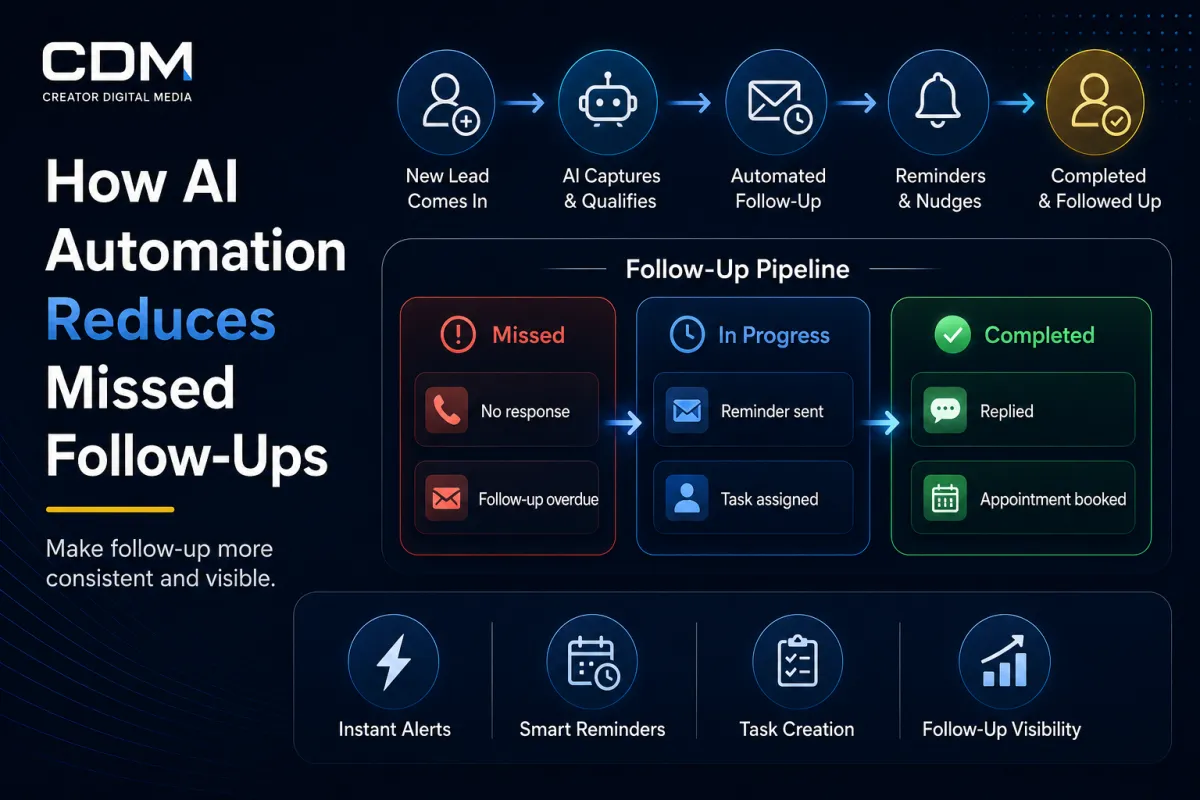
How AI Automation Reduces Missed Follow-Ups
Missed follow-ups are one of the quietest ways small businesses lose revenue. They usually do not look dramatic at first. A lead fills out a form and does not get a fast response. A prospect asks for more information and no one follows up. A customer needs a reminder and the task gets buried. A quote is sent, but there is no next step. Over time, those small gaps become a real operational problem.
For many small businesses, the issue is not lack of effort. It is that follow-up depends too much on memory, manual tracking, and disconnected tools. When the owner or team is busy, follow-up becomes inconsistent.
AI automation can help reduce that risk by making follow-up more visible, more consistent, and easier to manage. The goal is not to replace human relationships. The goal is to make sure important next steps do not fall through the cracks.
Why follow-up breaks down
Follow-up usually breaks down for ordinary operational reasons. A lead comes in after hours. A phone call is missed during a busy part of the day. A form submission goes to an inbox that is not checked quickly enough. A team member plans to follow up later, but another task takes priority. A customer conversation happens in one system while the reminder lives somewhere else.
These are normal small business problems. They become expensive when they happen repeatedly.
Follow-up gaps can affect:
· New lead response
· Appointment confirmations
· No-show recovery
· Proposal follow-up
· Customer onboarding
· Payment or document reminders
· Service check-ins
· Re-engagement campaigns
The more the business grows, the harder it becomes to manage those follow-ups manually.
Where AI automation helps
AI automation helps by connecting the event, the next action, and the reminder. Instead of relying on someone to remember every step, the workflow can trigger the right follow-up at the right time.
For example, when a new lead submits a form, the system can send an immediate acknowledgment, notify the team, create a CRM opportunity, assign a task, and schedule a follow-up reminder. If the lead does not book or respond, the workflow can trigger a second message later.
That kind of automation does not need to be complicated. It simply makes the business more consistent.
The value is especially strong in service businesses where timing matters. If a prospect is actively looking for help, the business that responds clearly and quickly usually has an advantage.
Good follow-up automation starts with a clear workflow
Before building automation, the business needs to define what should happen. AI and automation work best when the follow-up process is specific.
The business should answer:
· What action should trigger the follow-up?
· Who should be notified?
· What message should the customer receive?
· How soon should the follow-up happen?
· What should happen if the person does not respond?
· When should a human step in?
· How will the business know the follow-up happened?
Without those rules, automation can create more confusion. With those rules, automation becomes an operating layer that supports the team.
Common follow-up workflows to automate
Small businesses do not need to automate every follow-up at once. The best approach is to start with one workflow where missed follow-up already creates friction.
1. New lead follow-up
When a new lead comes in, the first response should not depend on someone noticing an email. Automation can acknowledge the inquiry, send next-step instructions, create a task, and alert the right person.
2. Missed-call follow-up
A missed call can become a missed opportunity. A follow-up text or message can quickly ask how the business can help, collect basic details, and route the person to the next step.
3. Appointment reminders and no-show follow-up
Appointment reminders reduce confusion for customers and protect the business schedule. If someone misses an appointment, an automated follow-up can make rescheduling easier.
4. Proposal and quote follow-up
Many proposals are sent and then forgotten. Automation can remind the business to follow up, send a polite check-in, or create a task for the owner or sales person.
5. Customer onboarding reminders
After a customer says yes, the business may need information, forms, access, documents, or scheduling details. Automated reminders help keep onboarding moving without constant manual chasing.
6. Re-engagement follow-up
Past leads and inactive customers often sit untouched in the CRM. Automation can help identify who should receive a check-in and when.
AI should support the message, not overtake it
AI can help draft, personalize, summarize, and route follow-up communication. But the business still needs to decide what tone, timing, and boundaries are appropriate.
For customer-facing follow-up, the message should be clear, helpful, and consistent with the business. The best automation does not sound robotic. It sounds like the business is organized.
In many cases, the first version of a follow-up workflow should keep the messaging simple. A short response, a clear next step, and a human escalation path are usually better than a complicated sequence.
What to measure
A follow-up workflow should be measured. Otherwise, the business will not know whether automation improved anything.
Useful measurements include:
· Response time
· Number of missed leads
· Follow-up completion rate
· Appointments booked
· No-shows reduced
· Quotes followed up
· Tasks completed
· Revenue recovered from re-engagement
The first measurement does not need to be advanced. Even knowing that every new lead now gets an immediate response can be a meaningful improvement.
Do not automate a messy process without review
There is one important caution: automation should not hide a broken process. If the follow-up message is unclear, the handoff is vague, or no one owns the next step, automation will not fix the underlying issue.
The workflow still needs an owner. Someone should review the results, check missed steps, update the message, and decide when the process should change.
A simple follow-up automation should have:
· A clear trigger
· A clear message
· A clear owner
· A clear next step
· A clear review point
That is enough structure for many small businesses to start improving follow-up without overcomplicating the system.
Final thought
Missed follow-ups are not just administrative issues. They affect revenue, customer experience, trust, and operational visibility.
AI automation helps small businesses reduce those gaps by making follow-up more consistent and easier to manage. The best starting point is not a complex system. It is one repeated follow-up workflow that matters enough to fix.
Creator Digital Media helps small businesses identify where AI automation fits, map focused workflows, and build systems that support real business operations. If your business is losing opportunities because follow-up depends too much on memory or manual tracking, the next step is to map the workflow and make the follow-up system more reliable.
Ready to identify where AI or automation could improve your business operations?