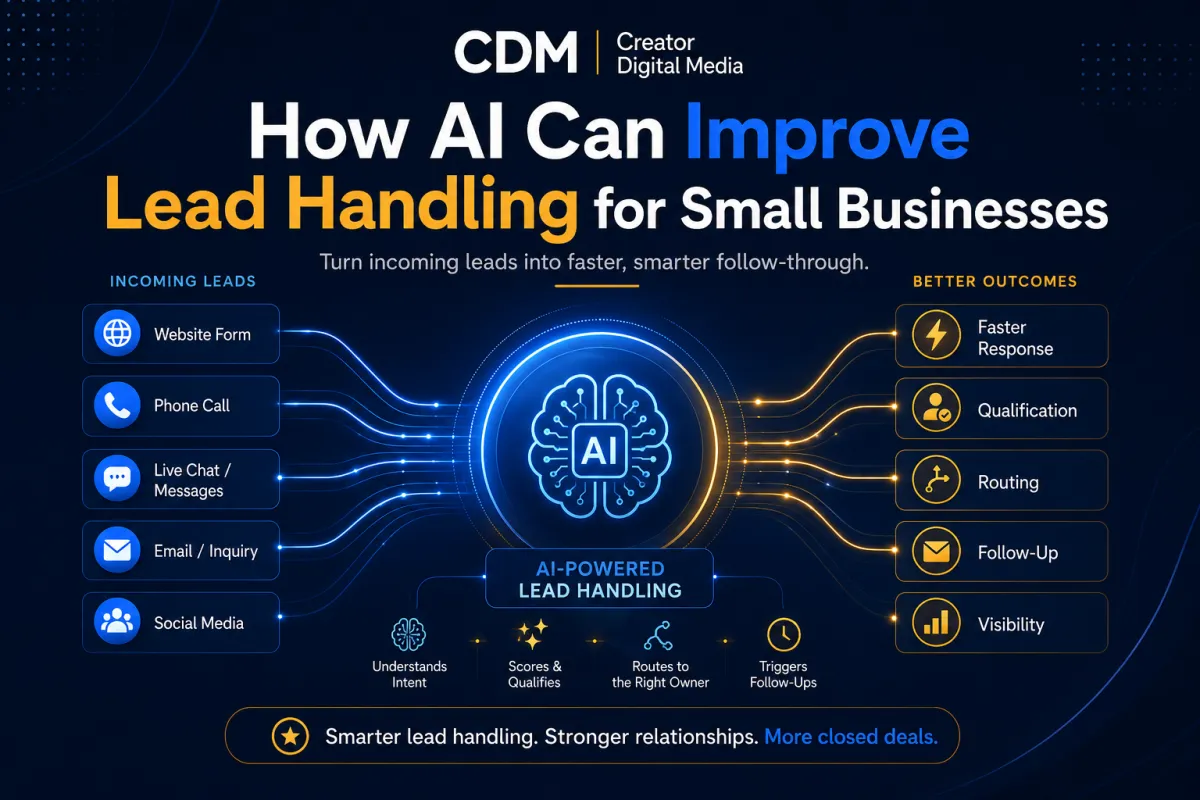
How AI Can Improve Lead Handling for Small Businesses
Lead handling is one of the strongest operational areas for a small business to use AI and automation. It is also one of the easiest places to lose revenue when the process is slow, inconsistent, or too dependent on memory.
A lead may come from a website form, phone call, email, chat message, referral, Google Business Profile, social media, or a direct message. The source can vary, but the business need is the same: respond quickly, collect the right information, route the lead, follow up, and keep visibility into what happened.
Many small businesses do not have a lead volume problem first. They have a lead handling problem. The issue is not always that there are not enough inquiries. The issue is that the inquiries are not always captured, answered, qualified, tracked, and followed up consistently.
AI can help, but only if it is connected to a clear lead handling workflow.
What lead handling means
Lead handling is the process a business uses to manage a new inquiry from first contact to next step.
That process may include:
· Capturing the lead
· Responding to the inquiry
· Asking qualifying questions
· Collecting contact details
· Routing the lead to the right person
· Booking an appointment
· Creating a CRM record
· Assigning a task
· Sending reminders
· Following up after no response
· Tracking whether the lead moved forward
When this process is clear, the business has a better chance of converting interest into a conversation, appointment, quote, or sale. When the process is unclear, good leads can sit unanswered, get buried in inboxes, or depend on the owner remembering to follow up later.
Where AI can help first
AI can support lead handling in several high-impact ways. The goal is not to remove human judgment. The goal is to reduce missed steps and improve the speed and quality of first response.
1. Faster first response
Speed matters when someone reaches out to a business. If a lead fills out a form or calls and does not get a timely response, they may keep searching.
AI and automation can help send an immediate acknowledgment, ask for basic information, or route the lead to the next step. This does not mean every response should pretend to be a human salesperson. It means the business should not leave the person wondering whether anyone received the inquiry.
A useful first response might confirm that the inquiry was received, ask one or two focused questions, and explain what happens next.
2. Better lead capture
Lead capture is not just collecting a name and email address. It is collecting enough information to understand what the person needs and how the business should respond.
AI chat, forms, and automated intake workflows can help collect details such as service interest, location, urgency, budget range, preferred contact method, timeline, and the reason for the inquiry.
This helps the business avoid starting every conversation from zero.
3. Lead qualification
Not every inquiry is the same. Some leads are ready to book. Some need education. Some are not a fit. Some need to be routed to a specific service path.
AI can help ask qualifying questions and summarize the answers before a person reviews the lead. This can save time and help the team prioritize the right opportunities.
For small businesses, lead qualification should stay simple. The goal is not to build a complicated scoring model too early. The goal is to identify who needs a fast response, who needs more information, and who may not be a good fit.
4. Missed-call follow-up
Missed calls are a common leak in service businesses. If a customer calls and no one answers, the business may never know what they needed unless a strong follow-up process exists.
AI and automation can help by sending a follow-up text, asking what the caller needs, collecting basic details, and creating a task for the business to respond.
Voice AI can also support after-hours or overflow conversations, but the first step can be much simpler: make sure missed calls trigger a clear follow-up process.
5. CRM updates and task creation
A lead handling workflow is only useful if the information ends up where the business can act on it.
Automation can create or update the contact record, add tags, assign a task, move the opportunity to the correct pipeline stage, and notify the right person. AI can help summarize the inquiry so the business can quickly understand the context.
This is where many businesses get operational value. The lead is not only captured. It becomes visible and actionable.
6. Follow-up consistency
Many leads do not convert on the first touch. They need a reminder, additional information, a second message, or a scheduled follow-up.
AI-assisted automation can help draft follow-up messages, trigger reminders, and keep the lead from disappearing after the first conversation.
The business still needs judgment. Not every lead should receive the same message. But automation can make sure follow-up happens instead of depending entirely on memory.
Why the workflow matters more than the tool
AI will not fix a lead handling process that has not been defined.
Before adding a tool, the business should answer a few operational questions:
1.Where do leads come from today?
2.Who receives them?
3.How quickly are they answered?
4.What information should be collected?
5.What makes a lead qualified?
6.What happens after the first response?
7.Where should the lead be tracked?
8.Who owns follow-up?
9.How will missed leads be identified?
These questions expose the actual process. Once the workflow is clear, AI and automation can support it.
A simple lead handling workflow
A small business does not need a complicated system to start. A clear lead handling workflow may look like this:
10.Lead comes in from a form, call, chat, email, or social channel.
11.The lead receives a fast acknowledgment or next-step message.
12.The system collects missing details if needed.
13.The contact record is created or updated in the CRM.
14.The opportunity is placed into the correct pipeline stage.
15.The right person receives a notification.
16.A follow-up task is created.
17.A reminder is triggered if there is no response.
18.The business reviews lead activity regularly.
This type of workflow creates visibility. It also reduces the chance that a lead is missed simply because someone was busy.
What to measure
Lead handling improvements should be measured with simple business metrics.
Useful measures include:
· Average response time
· Number of missed calls followed up
· Number of new leads captured
· Number of leads with complete intake details
· Number of appointments booked
· Number of follow-up tasks completed
· Number of leads lost due to no response
· Pipeline stage movement
· Conversion from inquiry to consultation or appointment
The point is not to measure everything at once. Start with the numbers that show whether the workflow is improving.
What small businesses should avoid
Small businesses should avoid overbuilding lead handling too early.
Common mistakes include:
· Adding too many tools before the workflow is mapped
· Automating messages that sound generic or confusing
· Letting AI answer questions without clear source information
· Failing to define when a human should step in
· Creating too many pipeline stages
· Not reviewing whether follow-up actually happened
· Treating every lead the same
The better approach is to start with one clear improvement. For example, missed-call follow-up, website lead intake, or consultation request routing.
The role of human review
Lead handling affects revenue and customer trust, so human review still matters.
AI can help collect information, summarize context, answer basic questions, and trigger next steps. A person should still review important inquiries, unclear requests, sensitive situations, pricing questions, and high-value opportunities.
The best systems do not remove accountability. They make accountability easier.
Where to start
For many small businesses, the best starting point is one of these:
· Website inquiry response
· Missed-call follow-up
· Consultation request intake
· Appointment booking support
· CRM task creation
· Follow-up reminders
Choose the area where leads are most likely to be missed or delayed. Then build a simple workflow around it.
Final thought
AI can improve lead handling when it is connected to a real business process. The value is not just faster messages. The value is better capture, better routing, better follow-up, and better visibility.
A small business does not need a complicated AI system to begin. It needs a clear lead handling workflow, a defined owner, and a reliable way to measure whether fewer opportunities are falling through the cracks.
Creator Digital Media helps small businesses map lead handling workflows, identify where AI and automation can help, and build systems that support faster response and stronger follow-through. If your business is losing leads through slow response, missed calls, or inconsistent follow-up, the next step is to map the lead handling process before adding another tool.
Ready to identify where AI or automation could improve your business operations?