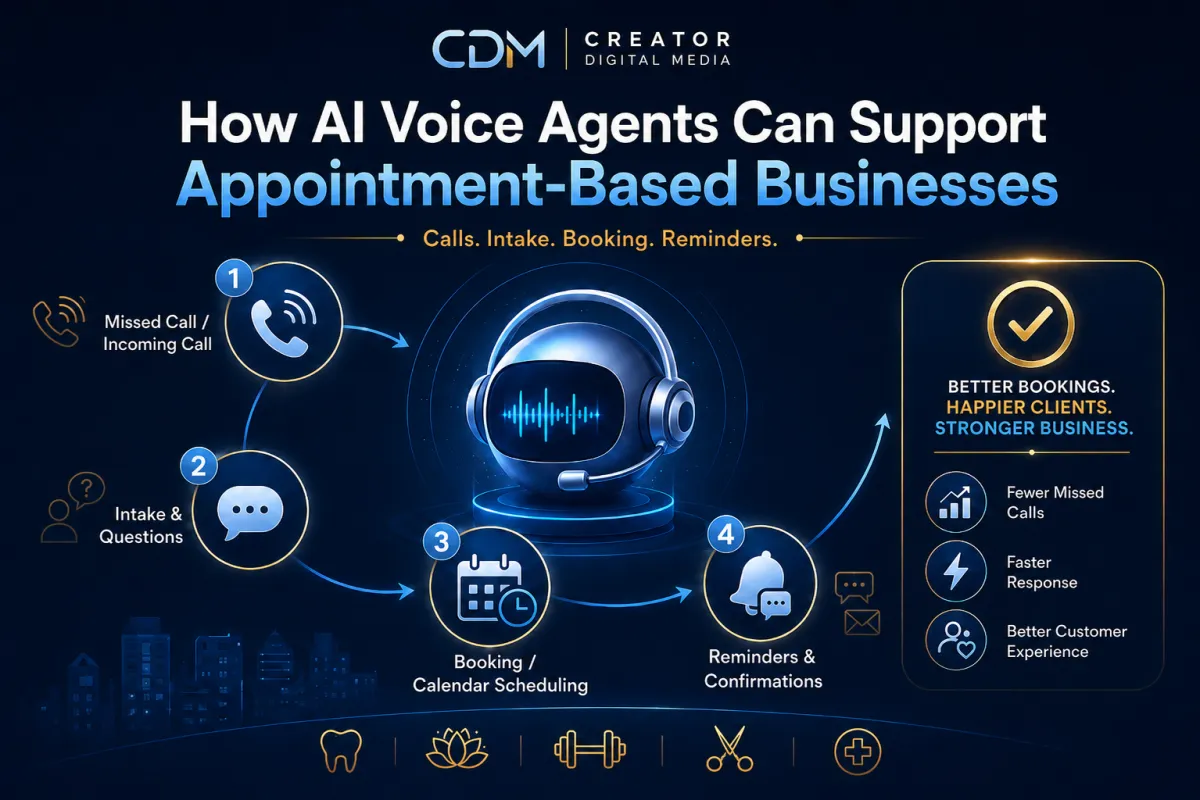
How AI Voice Agents Can Support Appointment-Based Businesses
Appointment-based businesses depend on timing. A customer calls to book. A lead wants to ask a question before scheduling. Someone needs to reschedule. Another person misses a reminder and does not show up. If the business does not respond quickly, the opportunity can move somewhere else.
This is where AI voice agents can be useful. Not because every conversation should be automated, but because many appointment-related calls follow a predictable pattern. The business needs to answer, collect information, route the person, book the appointment, confirm details, or trigger a follow-up.
For small businesses, the real value of voice AI is not sounding futuristic. The value is reducing missed calls, improving response speed, and keeping appointment workflows moving when the team is busy.
What an AI voice agent does
An AI voice agent is a system that can answer or place phone calls, follow a defined conversation flow, collect information, respond to common questions, and trigger next steps inside the business system.
In an appointment-based business, that may include answering basic service questions, collecting name and contact details, checking what the customer needs, offering scheduling instructions, sending a booking link, confirming appointment details, or escalating the call to a person.
The important point is that a voice agent should have a narrow job. It should not be expected to solve every customer issue or replace the entire front desk from day one.
Where appointment-based businesses can start
The best starting point is usually one repeatable call flow. A business should choose a call type that happens often, has clear rules, and creates friction when it is missed or delayed.
Good first use cases include:
· Missed-call response
· After-hours lead capture
· Appointment booking support
· Appointment confirmation calls
· Rescheduling assistance
· Customer intake before an appointment
· Basic FAQ handling
· No-show follow-up
These are strong starting workflows because they do not require the voice agent to handle every possible scenario. The job is specific and measurable.
Missed-call response
Missed calls are one of the clearest voice AI starting points. Many small businesses cannot answer every call, especially during appointments, service delivery, travel time, or after hours.
A voice agent or voice-enabled workflow can help by responding quickly, asking what the person needs, collecting basic details, and giving the business a cleaner record of the inquiry.
Even if a human still follows up later, the business has reduced the risk of losing the opportunity completely.
Appointment booking and scheduling support
Appointment booking is another strong use case because the conversation usually follows a structured path. The caller wants to know availability, service fit, pricing basics, preparation steps, or the next available time.
Depending on the business setup, the voice agent may not need to directly book the appointment. It may simply collect the request, send a booking link, route the call, or notify the right person to confirm.
For many small businesses, that level of support is enough to improve response time without creating a risky fully automated booking process.
Customer intake before the appointment
Customer intake is often repetitive. The business needs to know who the customer is, what they need, where they are located, what service they are requesting, and whether there are any special details before the appointment.
A voice agent can help collect that information and summarize it for the team. This can make the appointment more productive because the business is not starting from scratch when the customer arrives or joins the call.
For service-based businesses, better intake can reduce back-and-forth, improve preparation, and help the team deliver a more organized customer experience.
Appointment reminders and confirmations
No-shows and late cancellations create operational waste. They leave unused time on the calendar and disrupt the flow of the day.
Voice AI can support reminders and confirmations by contacting customers before the appointment, confirming key details, and identifying when someone needs to reschedule.
This does not need to be complicated. A simple confirmation workflow can help protect the schedule and reduce manual reminder work.
Human handoff still matters
A good voice AI setup should have a clear handoff path. Some calls should go to a person. Some questions should not be answered automatically. Some situations require judgment, empathy, negotiation, or escalation.
Before using a voice agent, the business should define:
· Which calls the agent can handle
· Which questions it can answer
· What information it should collect
· When it should transfer or escalate
· What it should never say or decide
· Who reviews call summaries and outcomes
This is what keeps the workflow useful instead of risky.
What to measure
A voice AI workflow should be measured like any other business process. The business should know whether the voice agent is helping.
Useful measurements include:
· Missed calls reduced
· Leads captured after hours
· Appointments booked or requested
· Appointment confirmations completed
· No-shows reduced
· Intake details collected
· Human follow-up tasks created
· Customer issues escalated correctly
The first version does not need a complicated dashboard. The business simply needs enough visibility to know whether the workflow is improving response and reducing manual effort.
What to avoid
Small businesses should avoid launching voice AI with too broad of a scope. A voice agent that tries to answer everything can create customer frustration and operational risk.
The better approach is to start small. Pick one workflow, define the call path, test it, review the results, and improve it before expanding.
The business should also avoid using voice AI without clear messaging, privacy expectations, or escalation rules. If the agent collects customer information, the business needs to know where that information goes and who can access it.
A practical starting framework
A simple voice AI rollout can follow this structure:
· Choose one call workflow
· Define the customer goal
· Write the call path
· Decide what information to collect
· Set handoff and escalation rules
· Connect the workflow to the CRM or calendar process
· Test internally
· Review call outcomes
· Improve before expanding
That is enough structure for many appointment-based businesses to begin safely and with clear operating boundaries.
Final thought
AI voice agents can help appointment-based businesses improve response speed, reduce missed calls, collect better intake details, and support scheduling workflows. The point is not to replace every phone conversation. The point is to make sure important calls and appointment steps do not fall through the cracks.
Creator Digital Media helps small businesses identify where voice AI fits, map clear call workflows, and connect those workflows to real business operations. If your appointment-based business is losing time or opportunities because calls, booking, or follow-up are inconsistent, the next step is to map the workflow before adding more tools.
Ready to identify where AI or automation could improve your business operations?