How Better Customer Data Can Reveal Repeat-Revenue Opportunities
A business may have years of invoices, service notes, and customer conversations without a clear view of who might need its help again. The information exists, but it is spread across records that were created to complete separate tasks.
One record shows the last service date. Another contains a future project mentioned during delivery. A team member remembers an upcoming renewal, but the CRM has no assigned follow-up. These gaps make relevant opportunities difficult to see and easy to miss.
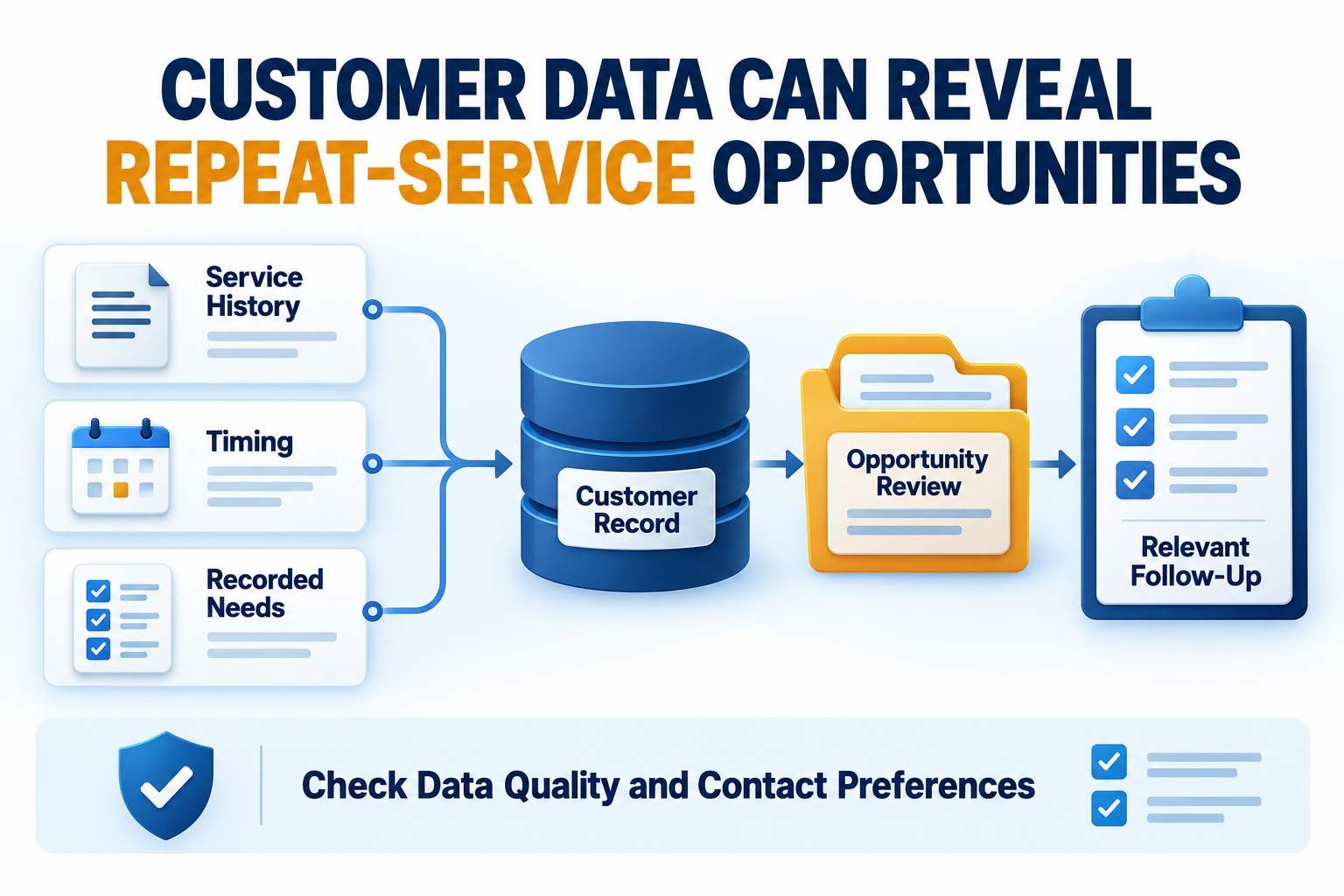
Better customer data connects those details so the business can review possible repeat work. It does not prove that a customer will buy again. It gives the team a documented reason to assess timing, service fit, and the next appropriate action.
Start With a Specific Customer Question
Choose one question the business wants to answer before building a report. Which completed services are approaching a normal repeat interval? Which customers asked to revisit a deferred need? Which agreements have a renewal date that requires review?
A narrow question helps identify the fields that matter. A report containing every available customer detail can become difficult to maintain and still fail to produce a useful next step.
Define the action the report should support. The result may be an internal account review, a service reminder, or a conversation about a recorded request. It should not automatically become a campaign to every customer in the database.
Make Service History Usable
The customer record should identify what was actually delivered and when. Keep completed work distinct from a quote, a canceled booking, or an item included in a proposal but never purchased. Those differences affect whether a future recommendation makes sense.
Use consistent service names and connect records to the correct customer or account. Duplicate contacts, inconsistent dates, and free-text descriptions can hide repeat work or cause the same opportunity to appear several times.
Begin with the records needed for the first use case. Correct the fields that drive the decision and record where important information came from. A smaller report built on checked history is more useful than a large list with uncertain meaning.
Connect Dates to a Business Reason
A date becomes useful when the team understands what it represents. A service completion date, a contract end date, and a customer’s requested follow-up date should not be treated as interchangeable.
For recurring work, document the basis for the expected interval. It may come from an agreement, a service plan, or a customer request. Where an interval is only an estimate, label it as something to review rather than a confirmed customer requirement.
Keep planned dates separate from verified events. A projected service date should not overwrite the actual completion date. If the customer postpones a decision, retain the history and update the next review date so the team can explain the change.
Use Recorded Needs to Assess Related Services
A related service may be relevant when it addresses a problem the customer has already described. For example, a customer who completed an initial setup may have asked to revisit ongoing support after the team has used the system.
Keep the source of that need visible. A conversation note, a submitted request, or an agreed project stage provides stronger context than an assumption based only on the original purchase.
Avoid treating a shared customer category as proof of interest. Customers who bought the same service may have different goals, budgets, and operating constraints. Review whether the business can explain how the proposed next step fits each relationship.
Keep Preferences and Open Issues in View
A potential opportunity should be reviewed alongside communication preferences, active conversations, and unresolved service issues. These details may change the timing, owner, or suitability of any outreach.
A past purchase does not establish that every channel or message is appropriate. Check the relevant record and the business requirements for the intended contact. If the basis is unclear, keep the item in internal review.
Customer information should support the decision without exposing unnecessary detail. Limit report access to the people who need it and avoid copying sensitive service notes into campaign fields or message drafts.
Turn a Signal Into a Reviewable Opportunity
Define the evidence that places a record on the review list. The rule might combine a completed service, a relevant date, and no active task for the same need. Include a reason for the flag so the owner does not have to reconstruct the report logic.
Keep the initial label modest. A possible repeat-service need is a signal for review. It becomes a qualified opportunity only after it meets the business’s stated criteria, which may require a conversation with the customer.
Build a Report That Leads to an Action
A useful report shows why a record needs attention and what the owner should do. Include the customer or account identifier, relevant service, supporting event or date, reason for review, assigned owner, next action, and current status.
Define one primary record for each potential need. Several contact records or transactions may support the same opportunity, but they should not create duplicate outreach. Agree on how related contacts within one account are handled.
Data signal | Question for review | Possible next action |
Recorded service interval is approaching | Does the service remain relevant and due? | Confirm the record and prepare an appropriate reminder |
Customer requested a later discussion | Has the agreed date or event arrived? | Assign the planned follow-up |
A related need appears in verified notes | Is the need still open and within service scope? | Review with the account owner |
Renewal date is approaching | What does the agreement require next? | Create a renewal review task |
Dates or outcomes conflict | Which record is accurate? | Resolve the data issue before outreach |
Record the Next Step After Service Completion
Update the customer history when work closes. Record any agreed future action, the reason for it, and the person responsible. This is the point where useful delivery context can otherwise disappear.
Our guide “The Post-Service Follow-Up Workflow Most Businesses Overlook” explains how completion confirmation, customer feedback, and issue routing connect to appropriate future contact.
When a customer says there is no further need, record that outcome as well. Accurate negative or closed outcomes help the team avoid repeatedly resurfacing the same suggestion.
Use AI to Prepare Evidence for Review
AI can help summarize service history, identify missing fields, suggest consistent service labels, or flag notes that mention an agreed future need. Keep a link to the supporting record so the reviewer can check the suggestion.
Do not allow AI to invent purchase intent, fill a missing date with a guess, or treat a related product as an accepted requirement. Uncertain classifications should remain visible as uncertain.
Before relying on the output, compare a sample against the underlying records. Check whether the system misses important exceptions or repeatedly flags the wrong type of customer.
Assign Ownership Before Expanding the Report
Every reviewed item needs a decision and an owner. Useful statuses may include Needs Data Correction, Ready for Owner Review, Follow-Up Agreed, No Current Need, and Closed. Define what each status means and who can change it.
If an opportunity moves into an active conversation, connect the report item to the CRM task or opportunity. That connection prevents the next refresh from creating another action for work already underway.
Measure Verified Outcomes
Track records reviewed, data issues corrected, relevant follow-ups agreed, qualified opportunities created, and completed service outcomes. Keep the reporting period and definitions consistent so the team can compare results.
A flagged record is not revenue. An inquiry is not a completed purchase. Decide whether a report is showing quoted value, booked work, invoiced amounts, or payments received, and label each measure clearly.
Also define how the business attributes an outcome to the follow-up process. A repeat purchase may already have been planned. Record the connection without claiming the report caused every sale that happened afterward.
Test One Opportunity Rule First
Choose one service and one documented signal, such as an agreed review date or repeat-service interval. Check the source records, define exclusions, assign an owner, and test the report using known examples.
Include duplicates, an open complaint, an existing opportunity, a changed customer preference, and a record with an uncertain date. Confirm that the report sends each case to the correct action or review status.
Review the first results with the people responsible for follow-up. If they cannot explain why a record was flagged or what should happen next, improve the rule before increasing the audience.
Use Customer History to Support Better Decisions
Reliable customer data helps a business see where another service may be relevant and where further contact would be premature. The value comes from connecting a documented signal to a sound decision and completed follow-up.
Creator Digital Media provides AI Growth Support to help businesses review customer records, connect service history to opportunity reporting, assign follow-up, and measure verified outcomes.