How to Build an AI Consulting Budget for 2027
If your business plans to invest in AI in 2027, the budget should begin with the decisions you need to make, not a shopping list of software. Consulting, assessment, technology, employee time, and ongoing support may all be necessary, but they do different jobs. Putting them into one undifferentiated line item makes it difficult to approve projects or understand what you are paying for.
An AI consulting budget should show what help the business needs, what that help will deliver, and what must happen after recommendations are made. The result is a spending plan leaders can review, adjust, and connect to specific business priorities.
Start with the business problem and the decision ahead
Before requesting a consulting proposal, identify the operating problem or decision you want to address. Perhaps customer inquiries are routed inconsistently, teams cannot find current process information, or leadership wants to evaluate AI opportunities across departments. Each situation calls for a different scope of work.
Write down the current condition, the desired improvement, the department responsible, and the information needed to make a decision. A well-defined problem helps prospective advisors estimate the work and prevents the budget from expanding into unrelated projects.
Separate consulting work from the full cost of adoption
A proposal for AI consulting may cover diagnosis, planning, or guidance. It may not include software subscriptions, systems integration, staff training, or ongoing technical support. Clarify these distinctions before building the total budget.
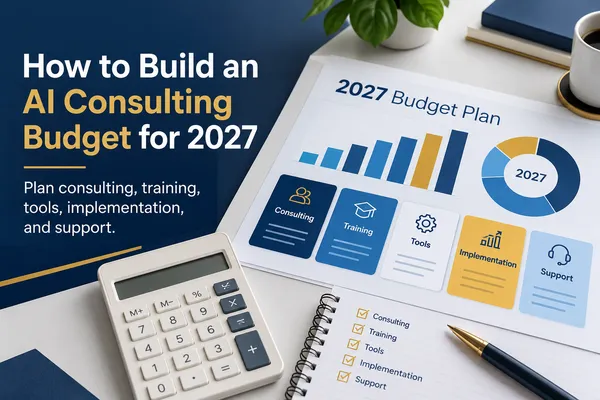
Budget category | What the business may need to fund |
AI consulting and advisory | Business discovery, decision support, evaluation, scope definition, leadership guidance |
Assessment and strategy | Current-state review, risk and opportunity findings, priorities, roadmap, implementation requirements |
Implementation and integration | Configuration, workflow development, connections between systems, testing, and deployment |
Technology and usage | Software subscriptions, usage charges, data access, approved third-party services |
People and education | Internal project owner, staff participation, job-specific education, documentation, review time |
Governance and oversight | Security and privacy review, permissions, approval controls, monitoring and policy updates |
Support and improvement | Issue resolution, maintenance, reporting, quality checks, and future adjustments |
Not every project needs every category. What matters is documenting which costs are included, excluded, conditional, or dependent on another activity.
Choose the consulting engagement before estimating its cost
For a business that has not decided where AI belongs, a limited discovery or assessment engagement may be sufficient to identify options. If leaders already understand the current environment but need direction, a strategy engagement can concentrate on priorities and sequencing. If a project is approved but difficult to coordinate, advisory assistance may focus on requirements, decisions, testing, or adoption.
Ask each prospective consultant to describe the work in business terms: what will be reviewed, who will participate, what decisions must be made, what deliverables will be provided, and what the business will still need to do. Compare proposals against the same scope instead of comparing price alone.
Use a phased budget instead of approving everything at once
A phased approach gives leadership checkpoints before larger commitments are made. The exact phases depend on the organization, but the sequence below is useful for many first projects.
Define the need. Assign an internal owner, document the problem, and agree on the decision to be made.
Assess and plan. Fund only the discovery, audit, or strategy work required to determine whether a proposed initiative deserves investment.
Validate a limited use case. Estimate technology, integration, staff time, review requirements, and an agreed test period.
Review evidence. Compare the results with the starting condition, record issues, and decide whether to stop, revise, or expand.
Fund ongoing ownership. Include support, usage, training refreshers, monitoring, and periodic changes after launch.
A phase should conclude with a clear decision and a named approver. This helps avoid treating initial approval as a commitment to every later expense.
Account for internal staff time
External invoices are easy to see; internal effort is often overlooked. Your operations lead may need to document the current process. Employees may join discovery interviews, test results, check accuracy, and learn new procedures. IT, security, finance, or legal staff may also need to review selected systems and data handling.
Estimate the hours or capacity required from each role. Identify any work that will be delayed while employees participate. A project that looks inexpensive on a vendor quote can still create a substantial internal workload.
Budget for recurring costs and change
An AI system is not finished when it is turned on. A business may incur recurring software charges, variable usage fees, integration maintenance, review and escalation costs, and employee support needs. Model these separately from one-time consulting and setup costs.
Ask whether usage-based charges have limits or alerts, who reviews monthly consumption, and what happens when a workflow fails or produces an unacceptable output. Include a management reserve for justified changes, with an approval rule rather than an unrestricted allowance.
Create a decision-ready budget worksheet
For each proposed initiative, use a worksheet that can be reviewed by the person approving the spending. Start with the following fields:
Worksheet field | What to record |
Business outcome | Problem, desired change, and baseline measure |
Scope and deliverables | Services purchased, exclusions, acceptance criteria |
One-time costs | Assessment, advisory, implementation, initial training |
Recurring costs | Subscriptions, usage, support, monitoring, refresher education |
Internal resources | Owner, participating roles, estimated time |
Risk and approvals | Privacy/security review, permissions, spending authority |
Decision gates | When leaders approve, pause, change scope, or stop |
Measurement | How results will be reviewed and by whom |
Avoid assigning a return-on-investment percentage before the business has credible baseline and cost information. Estimate benefits as assumptions, then test them. Keep cost savings, service quality, response times, and staff experience distinct where they tell different stories.
A business example: improving incoming inquiry handling
Consider a service company receiving inquiries through a website, email, and phone. Some leads wait too long for a response, and employees do not always know who owns the next step.
The initial consulting scope might be a review of inquiry sources, assignment rules, customer records, and response delays. Strategy work could then identify whether routing, a shared knowledge resource, or AI-assisted drafting offers the best starting point. If the company chooses an automated workflow, implementation and support would be scoped separately.
The budget should distinguish the cost of the assessment from the cost of connecting systems, testing messages, training employees, maintaining records, and monitoring exceptions. Leadership can then authorize a limited first phase and expand only after evaluating results. This is an illustrative scenario, not a reported CDM client outcome.
Questions to ask before approving the 2027 budget
· What business decision or outcome is this spending intended to support?
· Which tasks and deliverables are included in consulting fees, and what is excluded?
· Who owns the project inside the organization?
· What software, usage, internal labor, and support expenses continue after the engagement?
· What security, privacy, access, and approval reviews are needed?
· When will leadership review progress and decide whether to proceed?
· What evidence would justify more funding, and what would cause us to stop?
Plan the spending around decisions, not products
A useful 2027 AI consulting budget makes the scope visible, separates one-time and recurring costs, assigns ownership, and gives decision-makers a way to evaluate the next commitment. It does not require every possible AI initiative to be funded in advance.
Creator Digital Media helps businesses assess AI opportunities, define priorities, and determine the consulting or implementation support appropriate to their needs. If your business is preparing its 2027 plan, we can discuss the decisions ahead, the information available, and a scope that fits your objectives.
Frequently Asked Questions
What should an AI consulting budget include?
Define the consulting scope and deliverables, then account separately for assessment, implementation, software, internal staff effort, education, governance, and ongoing support as relevant.
Should a business budget for AI consulting before selecting software?
Often, yes. Assessment or strategy assistance can help clarify needs and evaluate options before the business commits to technology.
How much should a business spend on AI consulting in 2027?
There is no reliable universal figure. The amount depends on the problem, the state of current processes and systems, the scope of outside assistance, staff capacity, and the intended implementation.
How do we avoid cost overruns on AI projects?
Use a clear scope, written exclusions, assigned owner, spending approval thresholds, phased decision gates, and separate tracking for recurring usage and support.