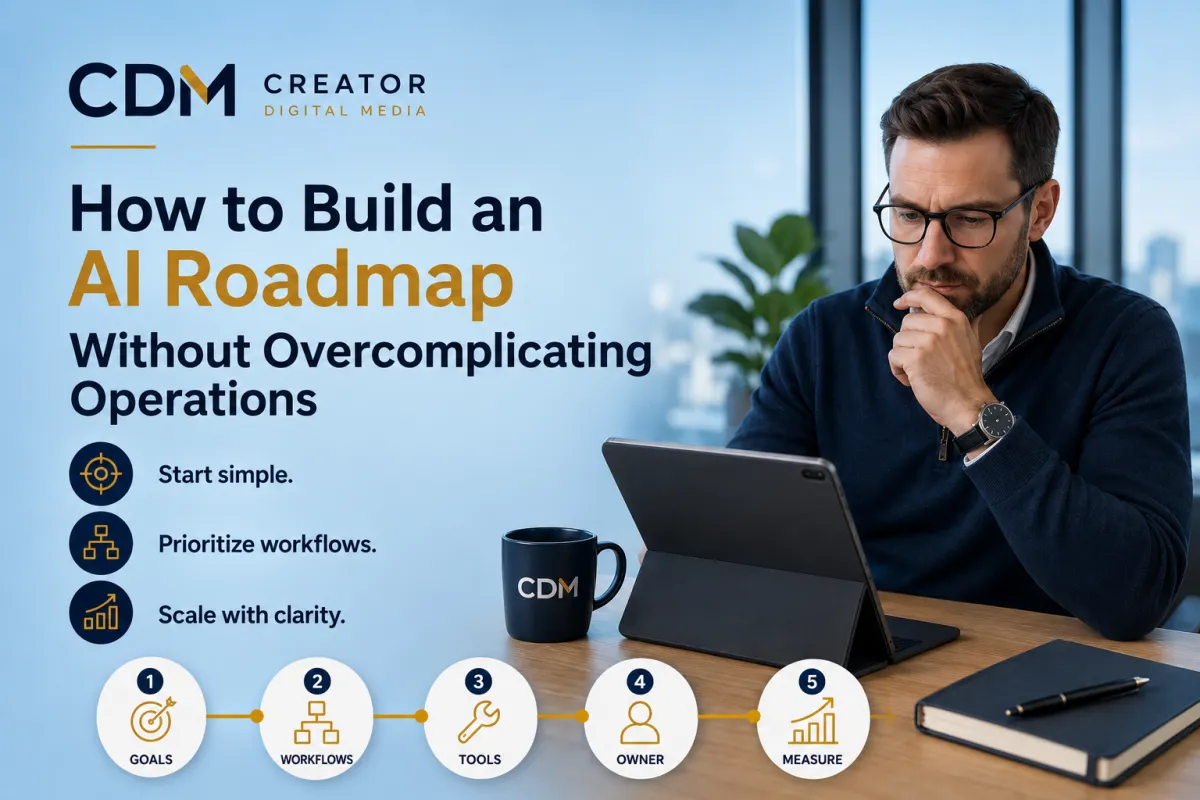
How to Build an AI Roadmap Without Overcomplicating Operations
A small business does not need a complicated enterprise AI roadmap to begin using AI well. It needs a focused plan that connects AI to the way the business actually operates.
The problem is that AI planning can quickly become too broad. Owners hear about chatbots, voice agents, automations, AI assistants, content tools, CRMs, reporting dashboards, and agentic workflows. The result is often too many ideas and no clear next step.
A useful AI roadmap should do the opposite. It should narrow the focus, define the first few priorities, and help the business move from scattered experimentation to controlled execution.
What an AI roadmap should do
An AI roadmap is not a long list of tools to try. It is a phased plan for improving business workflows with AI, automation, and better systems.
For a small business, the roadmap should answer five core questions:
• What business outcome are we trying to improve?
• Which workflow should be addressed first?
• What tool or system is needed?
• Who owns implementation and review?
• How will we measure whether the work helped?
Start with business priorities, not AI features
The roadmap should begin with the business, not the technology. A business owner should not start by asking which AI platform is most advanced. The better starting point is what needs to improve inside the company.
Examples include faster lead response, fewer missed follow-ups, cleaner customer intake, better appointment scheduling, more consistent content production, improved reporting, or less administrative work for the owner.
Once the business priority is clear, it becomes easier to decide which AI or automation use case is worth building first.
Map the workflows before choosing tools
AI works best when it is connected to a workflow that already has some structure. If the workflow is unclear, AI usually adds more confusion.
Before choosing a tool, document the current process in plain language. Identify where the work starts, what information is needed, who handles the task, where delays happen, and what the desired output should be.
This does not need to be complex. A simple workflow map is enough to show where AI could help and where human review is still required.
Build the roadmap in phases
An effective AI roadmap should be phased. The business should not try to automate every area at once.
A simple 90-day roadmap can be enough for most small businesses. The goal is to pick a few useful priorities and avoid turning the roadmap into a large internal project.
• Phase 1: clarify goals and identify workflow bottlenecks.
• Phase 2: select one or two use cases that are frequent, measurable, and useful.
• Phase 3: build or configure the first workflow with clear ownership.
• Phase 4: test, review, and improve the workflow before expanding.
• Phase 5: decide what should come next based on actual results.
Choose the first use case carefully
The first use case should be small enough to test but important enough to matter. This is where many businesses make a mistake. They either start with something too complex or pick something so minor that success does not change anything meaningful.
Good first use cases often involve repeated work, clear inputs, clear outputs, and visible business value. Lead intake, missed-call follow-up, scheduling, customer intake, reporting summaries, and CRM task reminders are strong examples.
Assign ownership before implementation
An AI roadmap without ownership is just a planning document. Every workflow should have a person responsible for setup, review, and improvement.
Ownership does not mean one person has to do everything. It means someone is accountable for whether the workflow is working, whether the outputs are useful, and whether the process should continue, change, or stop.
Keep governance simple but real
Small businesses do not need heavy enterprise governance to get started, but they do need basic rules. AI should not be added to customer communication, sales follow-up, internal reporting, or sensitive data workflows without clear boundaries.
At minimum, the roadmap should define what the AI system is allowed to do, when a human must review the output, what information should not be used, and how errors will be handled.
Measure what changed
The roadmap should include simple measures of success. Without measurement, it is hard to know whether AI improved the business or only added another tool to manage.
Useful measures include response time, missed leads reduced, follow-ups completed, manual hours saved, fewer errors, faster reporting, improved visibility, or more consistent customer experience.
The measurement does not need to be perfect. It needs to be useful enough to guide the next decision.
Avoid roadmap bloat
The easiest way to overcomplicate an AI roadmap is to include every possible idea. A small business roadmap should be selective. It should define what the business will do first, what it will delay, and what it will avoid for now.
Not every AI idea deserves a project. Some ideas are interesting but not urgent. Some are too risky. Some require better data or clearer workflows first. A useful roadmap creates focus.
Final thought
A good AI roadmap helps a small business move forward without losing control. It connects AI to real priorities, clear workflows, accountable ownership, and measurable results.
The roadmap does not need to be large. It needs to be useful.
Creator Digital Media helps small businesses identify high-value AI opportunities, build phased roadmaps, and implement automation workflows that support real operating needs. If your business is ready to use AI more intentionally, the next step is to map the roadmap before adding more tools.
Ready to identify where AI or automation could improve your business operations?