How to Choose the Right AI Model for Business Tasks
Using the most advanced AI system for every assignment may feel like the safest approach. It can also raise expenses without producing a meaningful improvement in results.
A meeting summary, data extraction request, or preliminary draft usually does not require the same level of reasoning as strategic planning, advanced software development, financial analysis, or a high-impact customer decision.
A more practical approach is to evaluate the work first, then select technology that provides the right balance of capability, reliability, speed, and cost.
This helps organizations control spending while reserving advanced tools for situations where they provide clear value.
Why One AI System May Not Fit Every Type of Work
Available AI systems vary in several important areas:
· price
· processing speed
· reasoning ability
· accuracy
· context capacity
· deployment options
· availability
· security controls
A high-capability platform may perform well on difficult assignments, but it can cost more and take longer to process requests. That additional power may offer little benefit when the underlying work is simple and predictable.
For example, many organizations do not need a frontier-level system to:
· summarize meeting notes
· classify incoming requests
· extract information from forms
· organize customer feedback
· prepare an initial content draft
· route a support ticket
A smaller commercial platform, open-source option, or lower-cost automation tool may handle those activities effectively.
More demanding work may justify stronger technology. Examples include:
· complex coding
· strategic analysis
· contract or policy review
· multi-step planning
· detailed research
· executive decision support
· situations where an incorrect result could create significant consequences
The best option is the one that completes the work dependably at a reasonable cost.
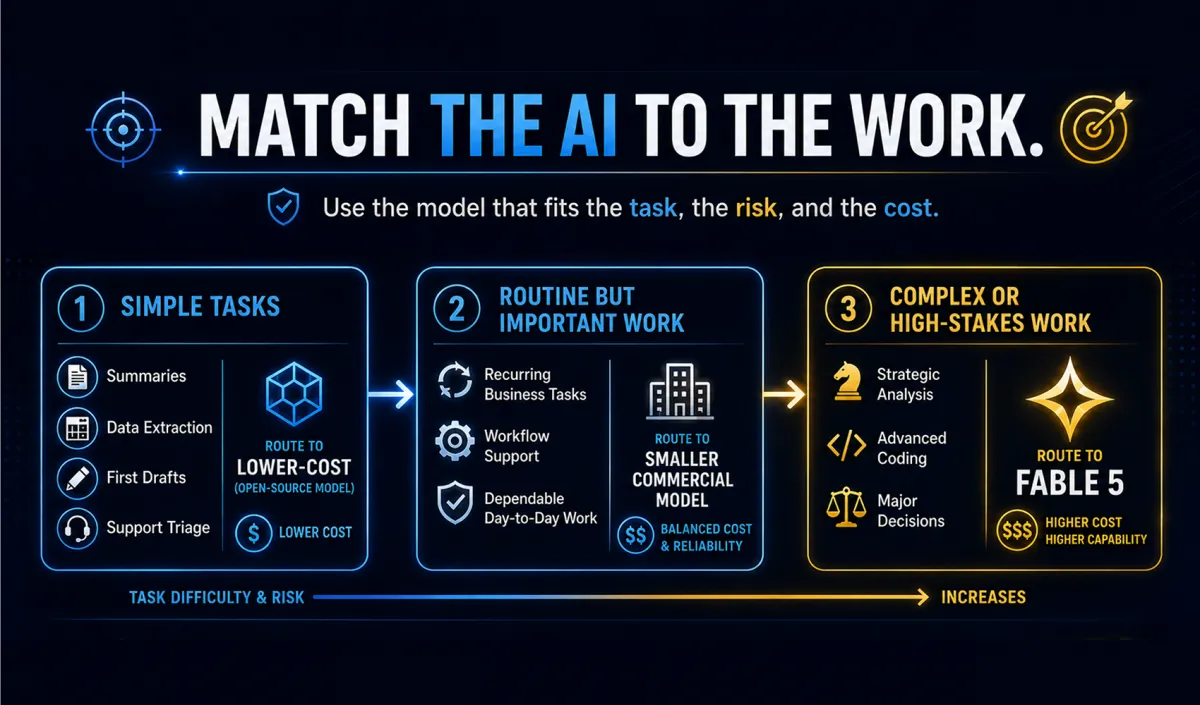
A Practical Three-Level Framework
A simple way to organize AI usage is to group activities into three levels.
Level 1: Simple and Repetitive Work
These activities follow a clear structure, involve limited ambiguity, and carry relatively low risk when corrections are needed.
· summarization
· data extraction
· document formatting
· tagging and categorization
· basic rewriting
· transcription cleanup
Lower-cost or open-source systems may be suitable for this category. Accuracy still matters, but advanced reasoning may not be necessary when the work follows a predictable pattern.
Level 2: Routine Operational Work
This category requires more context and judgment, but the activity still occurs regularly.
· drafting customer emails
· preparing internal reports
· creating marketing copy
· answering common support questions
· identifying action items from meeting notes
· developing early versions of proposals or procedures
A smaller commercial system may provide the right balance of quality, speed, and price. Human review should remain part of the process when the output affects customers, finances, brand reputation, contractual commitments, or other sensitive areas.
Level 3: Complex, High-Value, or High-Risk Work
These assignments may require deeper reasoning, longer context, specialized knowledge, or a higher degree of consistency.
· advanced software development
· strategic planning
· detailed financial analysis
· legal or regulatory research
· complex research synthesis
· executive-level decision support
· important customer or operational decisions
A frontier system may be appropriate in these situations. The higher expense can be justified when the work creates substantial value or when an error could result in financial, operational, legal, or reputational harm.
Five Questions to Ask Before Selecting a System
1. How difficult is the assignment?
A structured extraction request requires less reasoning than a multi-step strategic assessment. The level of technology should match the complexity involved.
2. What happens when the output is incorrect?
The consequences of an error should influence both the platform selected and the amount of human review required. An inaccurate internal summary may be easy to correct. A flawed financial recommendation or customer-facing response could create a larger problem.
3. How frequently will the process run?
A small price difference can become significant when an automation executes hundreds or thousands of times each month. High-volume processes deserve careful cost analysis.
4. How much value does the output create?
More capable technology may be appropriate when the result supports revenue, eliminates substantial manual effort, or improves an important decision. The expense should remain proportional to the benefit created.
5. What happens if the provider becomes unavailable?
Organizations should avoid allowing one platform to become a single point of failure. Access can change because of service outages, provider policy updates, capacity limits, price increases, security reviews, or regulatory restrictions. Important processes should have an alternate provider, backup system, or documented manual procedure.
The Lowest Price May Not Produce the Lowest Overall Cost
Controlling expenses does not mean choosing the cheapest option for every activity.
An unreliable system can create additional costs through:
· repeated corrections
· increased human review
· workflow delays
· poor customer experiences
· inaccurate data
· avoidable mistakes
A better standard is to select the least expensive option that can produce dependable results.
Reliability must be included in the cost calculation. A slightly more expensive platform may deliver greater value when it reduces rework, improves consistency, and requires less oversight.
Begin With the Workflow
Many organizations begin their AI planning by asking which tool they should purchase. A more useful starting point is the process they want to improve.
Identify a repeated activity that consumes time, causes delays, creates errors, or produces inconsistent results.
Then define:
· the information entering the process
· the expected output
· the required level of accuracy
· who will review the result
· the acceptable operating cost
· the consequences of failure
Once those requirements are clear, it becomes easier to evaluate available platforms. This workflow-first method reduces tool sprawl and creates a stronger basis for measuring performance.
Build a Small Portfolio of AI Capabilities
As adoption develops, many organizations will use several systems rather than relying on a single provider.
A practical setup may include:
· a lower-cost option for simple, high-volume work
· a dependable commercial platform for routine operations
· an advanced system for complex or high-value assignments
· an alternate provider for critical processes
This structure gives the organization greater control over spending, performance, and risk. It also reduces the disruption that can occur when pricing, access, or provider policies change.
How to Start
A small or growing company does not need to redesign every process at once. Begin with one repeated workflow.
1. Identify the activity.
2. Define the required result.
3. Estimate the time and cost of the current process.
4. Test two or more options using the same input.
5. Compare output quality, speed, consistency, and expense.
6. Add human review where the risk requires it.
7. Track performance for 30 days.
8. Keep the option that delivers the strongest operational result.
The purpose of introducing AI is to improve how work gets completed, not to increase the number of tools in use.
Final Takeaway
A strong AI strategy assigns the appropriate level of capability to each type of work.
Lower-cost systems may be sufficient for simple and repetitive activities. Dependable commercial platforms can support routine operations. Advanced technology should be reserved for assignments where complexity, value, or risk justifies the additional expense.
Critical processes should also include a backup option in case access, pricing, or provider policies change.
Match the AI to the work, then measure whether the workflow actually improves.
Ready to Turn AI Into a Competitive Advantage?
Creator Digital Media helps organizations identify practical AI opportunities, improve workflows, and develop automation strategies based on real operating needs.