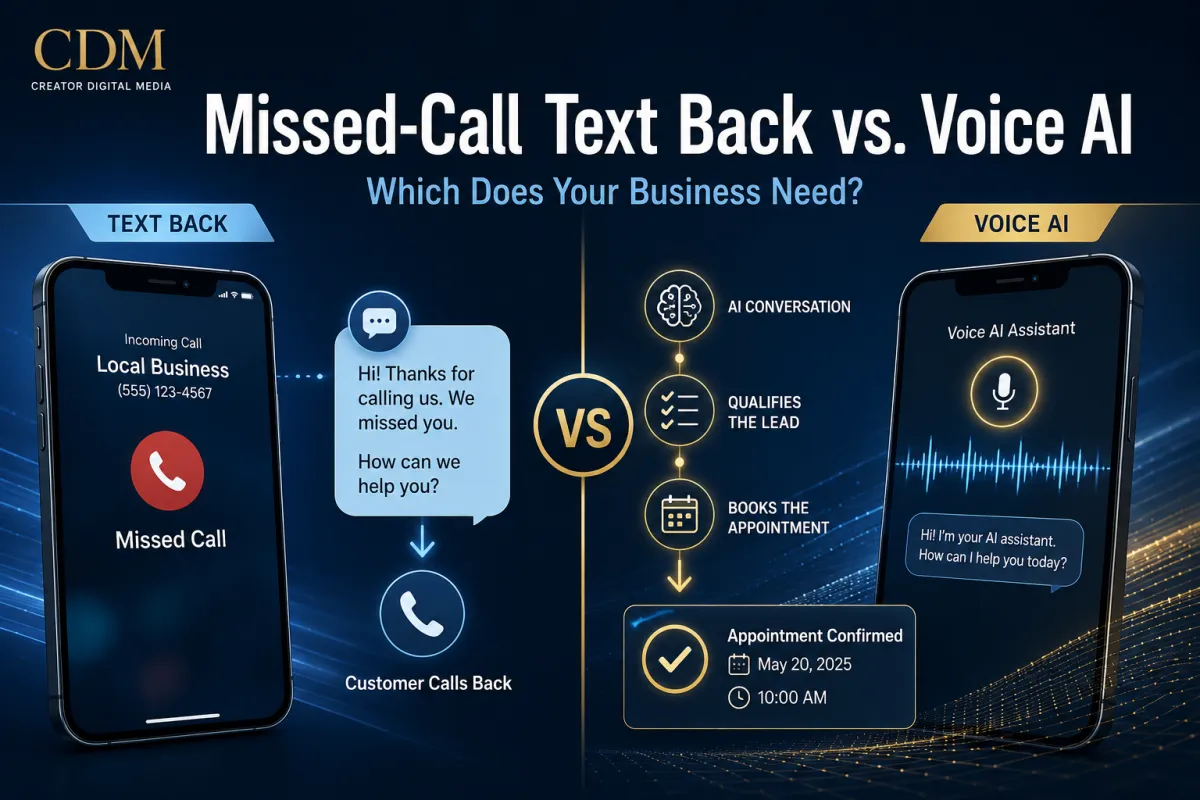
Missed-Call Text Back vs. Voice AI: Which Does Your Business Need?
A missed business call creates an immediate decision. Should the company send a text that invites the caller to respond, or should an AI voice assistant answer and handle the conversation while the person is still on the line?
Both options can reduce lost opportunities, but they solve different operating problems. A missed-call text-back system helps recover a conversation after the call has already ended. Voice AI is designed to keep the interaction moving by answering, gathering information, responding within an approved scope, and completing or routing the next step.
The right choice depends on why calls are being missed, what callers usually need, how quickly the business must respond, and how much of the conversation should be handled before a person steps in.
What Is Missed-Call Text Back?
Missed-call text back is an automation that sends an SMS message when an incoming call is not answered. The message confirms that the business received the call and gives the caller a way to continue by text, call again, use a link, or wait for a team member.
A useful workflow can create or update the CRM contact, identify the number that was called, assign an owner, preserve the source, and create a follow-up task. It can also stop later messages when the customer replies, books, or opts out.
This approach is often a strong first step when the main problem is delayed acknowledgment. It is less useful when callers expect immediate answers, need to describe a complex request, or want to schedule without exchanging several messages.
What Is Voice AI?
Voice AI uses an automated conversational assistant to answer or place phone calls within a defined business workflow. Depending on the setup, it may greet the caller, identify the reason for the call, answer approved questions, collect details, qualify the request, route the conversation, or schedule an appointment.
The assistant should operate from controlled information and clear rules. It needs boundaries for what it may say, what actions it may take, when it should transfer the call, and what information must be recorded in the CRM.
Voice AI requires more design and testing than a text-back message because it becomes part of the live customer experience. The value is also broader when the business needs coverage outside normal hours or receives calls that follow a repeatable path.
Side-by-Side Comparison
Decision area | Missed-call text back | Voice AI |
Best fit | Businesses that mainly need an immediate acknowledgment and a path for the caller to respond. | Businesses that need to answer, understand intent, handle common questions, qualify, route, or schedule during the call. |
Customer action | The caller must read the message and reply, call again, or select a link. | The caller can continue the conversation by voice without changing channels. |
Workflow depth | Usually a short recovery sequence with simple routing and follow-up. | Can support a structured conversation, collect details, trigger workflows, and complete approved actions. |
Setup effort | Lower. Requires message wording, timing, routing, consent controls, and CRM tracking. | Higher. Requires conversation design, knowledge, escalation rules, testing, integrations, and ongoing review. |
Human handoff | Occurs after the customer responds or a task is assigned. | Can occur during the call when the request meets a transfer or escalation rule. |
Main limitation | It cannot resolve the reason for the call unless the customer responds. | A weakly designed assistant can create a poor experience or take actions outside the intended scope. |
Choose Missed-Call Text Back When the Main Problem Is Acknowledgment
Missed-call text back is usually the better starting point when:
· Most calls occur during business hours, but employees occasionally cannot answer.
· A short message can preserve the opportunity until a person becomes available.
· Customers are comfortable continuing by text or using a scheduling link.
· The business needs a lower-complexity workflow before introducing a voice assistant.
· The team can reliably respond after the caller replies or the CRM creates a task.
The system still needs ownership. Sending a message without creating a visible next action can replace one missed call with an unanswered text conversation.
Choose Voice AI When the Conversation Must Continue Immediately
Voice AI becomes more useful when:
· A large share of calls arrives after hours, during appointments, or while employees are serving other customers.
· Callers commonly ask repeatable questions before they are ready to book or speak with a specialist.
· The business needs to collect qualifying details or route calls by service, location, urgency, or customer type.
· Immediate appointment scheduling is an important conversion step.
· The team needs CRM notes and workflow triggers created from the conversation.
· There are clear conditions for transferring the caller to a person.
Voice AI is not a substitute for every employee conversation. It is most dependable when its role is narrow, its information is current, and its handoff rules are easy to test.
Some Businesses Need Both
The decision does not always have to be either-or. A business may use Voice AI as the primary after-hours or overflow response and retain missed-call text back as a recovery path when a call disconnects, the assistant is unavailable, or the caller declines to continue by voice.
A combined system should not contact the customer twice without context. The CRM needs to recognize whether the call was answered, transferred, scheduled, abandoned, or missed before it launches the next action.
The operating rule should be simple: use the least complex method that can complete the customer’s next required step.
Five Questions to Answer Before Choosing
1. Why are calls being missed?
Separate occasional overflow from a consistent coverage gap. The answer affects whether acknowledgment is enough or live handling is required.
2. What do callers usually want?
Review call reasons. Scheduling, qualification, order status, service questions, and urgent requests require different conversation and escalation rules.
3. What must happen before a person takes over?
Define the minimum information, CRM update, appointment action, or routing decision the system should complete.
4. Where can the workflow fail?
Test unavailable calendars, incomplete caller information, unsupported questions, transfer failures, duplicate contacts, and after-hours exceptions.
5. How will success be measured?
Track answered or recovered calls, customer responses, qualified conversations, bookings, transfers, opt-outs, failed actions, and final outcomes.
Do Not Ignore Consent, Disclosure, and Data Controls
Texting, call recording, automated outreach, and AI-assisted conversations may be subject to consent, disclosure, privacy, and industry requirements. The exact obligations depend on the location, use case, communication method, and information involved.
Before launch, confirm applicable requirements with qualified counsel and configure the workflow accordingly. The system should also limit access to customer information, retain only necessary data, record opt-outs, and provide a dependable path to a person.
Frequently Asked Questions
Is missed-call text back the same as answering the call?
No. It begins after the call is missed. It can acknowledge the inquiry and invite a response, but the caller must take another action.
Can Voice AI book appointments?
It can when the approved workflow is connected to the correct calendar and includes availability, qualification, confirmation, and exception rules.
Is Voice AI always better than text back?
No. Voice AI adds capability and complexity. A text-back workflow may be the better choice when acknowledgment and human follow-up solve the actual problem.
Can a business start with text back and add Voice AI later?
Yes. Starting with a well-tracked text-back workflow can expose call patterns, response needs, and CRM requirements that inform a later Voice AI rollout.
Select the System Around the Customer’s Next Step
Choose missed-call text back when the business mainly needs to acknowledge callers quickly and create a reliable follow-up path. Choose Voice AI when the caller needs an immediate conversation that can gather information, answer within a defined scope, schedule, or route.
The technology should follow the workflow, not lead it. Start with the customer’s reason for calling, define the outcome the system must produce, and decide where a person should take control.
Creator Digital Media helps businesses evaluate missed-call patterns, map call-handling requirements, connect conversations to CRM workflows, and determine which response system fits the operation.