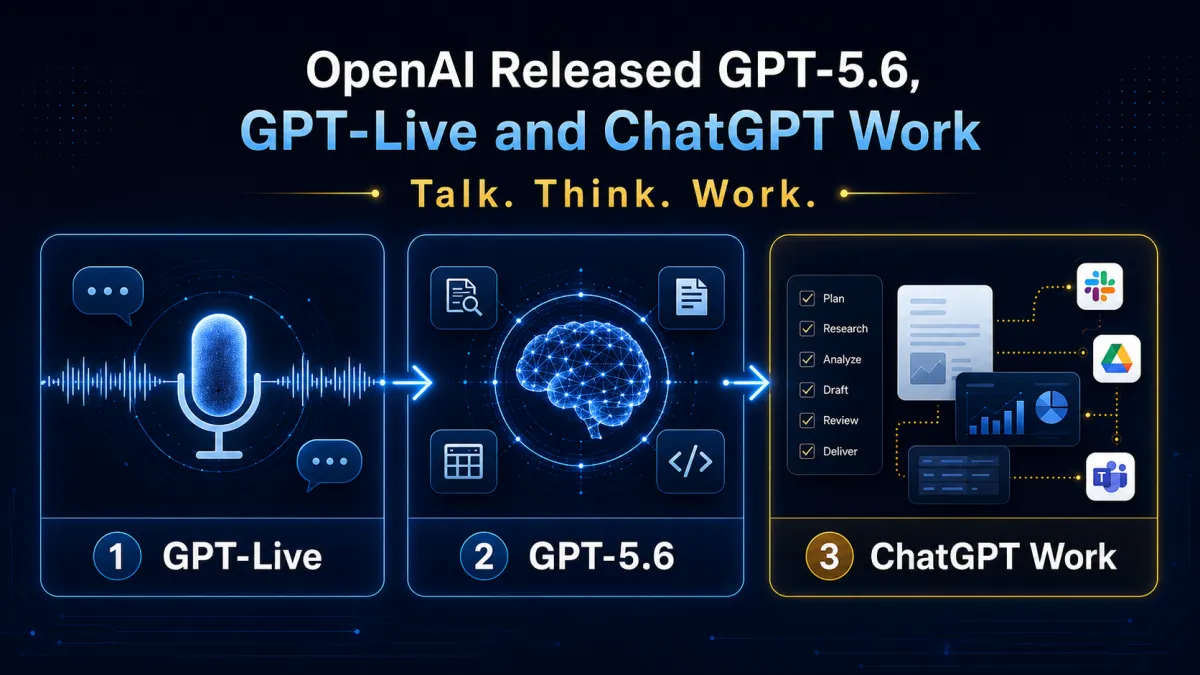
OpenAI Released GPT-5.6, GPT-Live and ChatGPT Work | Talk. Think. Work.
OpenAI released more than three product names: OpenAI released GPT-Live, GPT-5.6, and ChatGPT Work in the same week. For business owners, the important point is not the speed of the release cycle. It is the way these capabilities fit together.
One changes how people interact with AI. One improves the quality of reasoning and finishes work. One expands how much longer an assignment can be delegated.
Together, they create a practical progression: talk through the work, apply stronger intelligence to the work, and hand off more of the execution.
GPT-Live: talk through business work more naturally
GPT-Live is the interaction layer. It is designed for continuous voice conversations that can handle pauses, interruptions, follow-up questions, and changes in direction.
That matters because business thinking rarely happens in a perfectly written prompt. A founder may talk through a new service while commuting. A sales lead may prepare for a prospect call between meetings. A field operator may need to capture notes without stopping to type.
Useful starting points include brainstorming, meeting preparation, role-play, idea capture, and field updates. The value is not simply replacing typing. It reduces the friction between having an idea and turning it into structured work.
GPT-5.6: apply stronger reasoning where the work justifies it
GPT-5.6 is the intelligence layer. OpenAI is positioning it for stronger research, analysis, coding, documents, spreadsheets, presentations, computer use, and longer assignments.
For businesses, that can support competitor research, vendor comparisons, proposals, training materials, cash-flow models, forecasts, internal tools, and client-facing deliverables.
The operating lesson is that model choice should match the task. Routine, high-volume work may not require the most capable model. Higher value or more complex work may justify deeper reasoning and higher cost. The right question is not which model is best overall, but which model is reliable enough for this specific task at the right cost and risk level.
ChatGPT Work: move from isolated prompts to bounded execution
ChatGPT Work is the execution layer. It is designed for longer, multi-step assignments that can span files, applications, websites, and finished deliverables.
Potential uses include weekly management reports, prospect research, competitive monitoring, proposal development, project coordination, content production, and lightweight internal tools.
The best early use cases are not unrestricted or high-risk. They are documented, repetitive, easy to review, and valuable enough to measure. The business still needs to define the goal, available information, permitted applications, approval points, required deliverables, and completion criteria.
How the three releases work together
Consider preparing for a client meeting. GPT-Live can help the owner talk through the account, prior discussions, concerns, and desired outcome. GPT-5.6 can analyze the context, identify likely objections, and develop a meeting strategy. ChatGPT Work can assemble the brief, agenda, presentation, and follow-up materials.
The same pattern can apply to developing a service offering, producing a weekly marketing campaign, or reviewing business performance. Voice becomes the entry point, strong reasoning improves the quality of the work, and the execution layer handles more of the structured assignment.
That is the larger shift. The value is moving from a single prompt to a connected business process.
What businesses should do next
Start with one low-risk GPT-Live conversation, such as brainstorming, meeting preparation, or role-play.
Compare GPT-5.6 options on real work. Test a research task, document task, spreadsheet task, or development task. Measure quality, completion time, correction time, and cost.
Then choose one bounded workflow for ChatGPT Work. Select something repetitive, documented, low-risk, easy to verify, and useful enough to justify the effort.
Measure the result before expanding. Did the process save time, reduce manual steps, improve output quality, or create additional work that erase the benefit?
The business takeaway
OpenAI did not simply release three separate tools. It released a more connected way to interact with AI, improve the quality of business work, and delegate more of a defined assignment.
Start with one real workflow. Use voice where it reduces friction. Use stronger reasoning where the work warrants it. Delegate execution only where the boundaries and review points are clear.
Ready to Turn AI Into a Competitive Advantage?
Creator Digital Media helps organizations identify practical AI opportunities, improve workflows, and develop automation strategies based on real operating needs.