Should AI Write Your Responses to Customer Reviews?
AI can make customer review responses faster to draft, easier to organize, and more consistent in tone. That does not mean every response should be written and published without a person reviewing it.
A public reply represents the business. It may address a compliment, clarify a service concern, acknowledge a complaint, or signal to future customers how the company handles feedback. A weak response can create more damage than leaving the review unanswered for a short period while the facts are checked.
The better question is not whether AI should write review responses. It is which parts of the response process AI can support, which situations require human judgment, and who approves the final message.
What AI Can Do Well
AI is most useful when the business has clear response standards and the review does not involve an unusual or sensitive issue.
For routine feedback, an approved system can prepare a first draft, identify the topic, suggest an appropriate tone, and route the response to the correct owner. It can also help a team avoid repeating the same wording across every reply.
· Draft a concise thank-you for a positive review
· Summarize the main issue raised in a longer comment
· Classify the review by location, service, topic, or urgency
· Flag language that may require escalation
· Check a draft against approved tone and privacy rules
· Create a response task and assign an owner
· Track whether the response was reviewed and published
These uses save time because they support repeatable work. They do not remove the need to confirm the facts or decide what the business should say publicly.
Where AI Should Not Decide Alone
Some reviews require context that a drafting tool may not have. A complaint may involve a billing record, missed appointment, employee interaction, service guarantee, legal issue, health information, or unresolved dispute.
In those situations, AI should not guess, make a promise, assign blame, or publish a response based only on the public review. The system should pause and send the case to a person with access to the relevant records and authority to decide the next step.
Human review should be required when a review includes:
· A serious complaint or threat
· Private or sensitive customer information
· A refund, credit, warranty, or compensation request
· An allegation about an employee or contractor
· A safety, legal, financial, or regulatory concern
· Facts that conflict with the business record
· Harassment, discrimination, or abusive language
· A situation already being handled through service recovery
Start With Response Standards
AI cannot create a dependable response process if the business has not defined what a good reply looks like. Before using it, set standards for tone, length, privacy, escalation, approval, and ownership.
The standards should be specific enough to guide a draft without forcing every review into the same template. A short positive comment may need a brief thank-you. A detailed compliment may deserve a more specific acknowledgment. A complaint may need only a neutral public reply followed by private contact.
At minimum, document:
· The business voice and words to avoid
· The expected response length
· When to mention the service or location
· Information that must never appear publicly
· Which reviews can use a standard approval path
· Which topics require escalation
· Who may approve and publish each response type
Use Facts the Business Can Verify
A response should not invent details to sound personal. If the system knows only the review text, it should not assume which employee served the customer, what happened during the visit, or whether the business caused the problem.
Connect the workflow only to approved information that is needed for the response. If the facts are incomplete, the draft should stay general or request human review.
The public reply should acknowledge the customer without exposing order details, appointment information, contact data, account history, or internal notes.
Avoid Copy-and-Paste Replies
Consistency is useful, but identical responses make the business appear inattentive. Customers and future readers can see when every reply follows the same sentence pattern.
A better approach uses a limited set of approved response structures while varying the language according to the actual review. The response can mention a specific compliment or concern without repeating private information.
AI should help the team write more efficiently, not turn the review section into a collection of near-duplicate messages.
Keep Public Responses Separate From Service Recovery
A public response and a private resolution process serve different purposes. The public reply should acknowledge the feedback, show that the business takes the issue seriously, and offer an appropriate next step. It should not contain a full investigation, personal details, or an argument about what happened.
The service-recovery workflow should assign the issue, gather the facts, contact the customer through an approved channel, document the outcome, and decide whether another public response is needed.
Linking these workflows helps the business respond calmly in public while still addressing the underlying problem.
Build an Approval Matrix
Not every review needs the same level of review. A simple approval matrix can keep routine responses moving while protecting higher-risk situations.
Review type | Recommended handling | Approval |
Short positive review | AI-assisted draft using approved tone | Assigned reviewer |
Detailed positive review | Specific draft referencing the public feedback | Assigned reviewer |
Neutral or mixed review | Draft plus issue check | Manager or account owner |
Negative review | Pause, verify facts, and start service recovery | Manager or designated owner |
Sensitive or high-risk review | No automated reply; escalate immediately | Authorized decision-maker |
Require Final Approval Before Publishing
For most small businesses, the safest starting point is AI-assisted drafting with human approval. The reviewer confirms the facts, removes unsupported claims, checks privacy, adjusts the tone, and verifies that the proposed next step is available.
Approval should be recorded so the business knows who reviewed the response and when it was published. If the team later expands automation, it can do so using evidence from a controlled process rather than assuming every routine response is safe.
The person approving the reply should be able to reject the draft, rewrite it, send it for escalation, or pause publication.
Measure the Process, Not Just Response Speed
Faster replies can help, but speed alone does not show whether the system is working. Track measures that reveal quality, control, and customer follow-through:
· Reviews received and classified
· Time from review to first internal assignment
· Time from review to approved public response
· Percentage of drafts accepted, edited, rejected, or escalated
· Repeated complaints by topic or location
· Service-recovery cases opened and resolved
· Privacy or accuracy corrections
· Unanswered reviews and overdue approvals
A high edit or rejection rate may show that the instructions, source information, or approval categories need improvement. Repeated complaints may point to an operating problem that better wording cannot solve.
A Controlled Review-Response Workflow
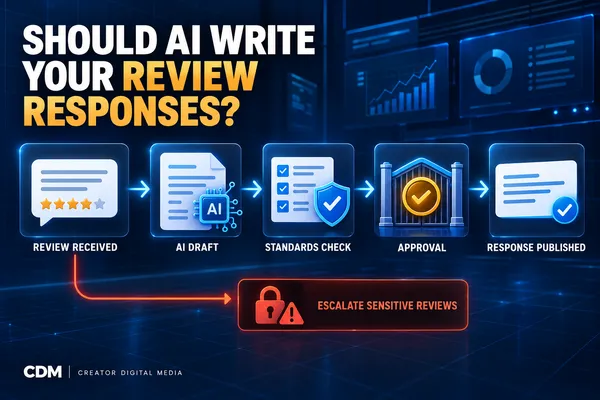
Capture the review and link it to the correct business location.
Classify the sentiment, topic, urgency, and potential risk.
Route sensitive, negative, or unusual cases directly to a person.
Prepare an AI-assisted draft only from approved public and business information.
Check the draft against tone, privacy, accuracy, and escalation rules.
Require the assigned person to approve, revise, reject, or escalate it.
Publish the approved response and record the action.
Open a separate service-recovery task when the customer issue requires private follow-up.
Review response quality, exceptions, and repeated complaint themes each month.
Use AI to Support Judgment, Not Replace It
AI can reduce the time required to classify reviews, prepare first drafts, check standards, and route exceptions. The business still owns the facts, tone, promises, privacy decisions, and final response.
Start with a controlled workflow: approved response standards, clear escalation categories, human review, recorded approval, and a separate path for service recovery. Expand only after the process produces accurate and appropriate responses consistently.
Creator Digital Media helps businesses design review-response workflows, define approval rules, connect reputation activity to customer records, and create reporting that shows where service and communication need attention.
Frequently Asked Questions
Can AI automatically respond to every customer review?
It can technically automate routine replies, but automatic publication is not the best starting point for most businesses. Use AI-assisted drafts with human approval until the business has reliable standards, accurate context, tested escalation rules, and clear ownership.
Should a business respond to every review?
A business should define a consistent response policy based on its volume, channels, and customer expectations. Prioritize complaints, questions, detailed feedback, and reviews that need acknowledgment. Do not publish filler merely to increase the response count.
Can AI respond to negative reviews?
AI can help summarize the issue or prepare a cautious draft, but a person should verify the facts and approve the response. Complaints involving sensitive details, disputes, promises, or service recovery need direct human ownership.
How can a business prevent AI review responses from sounding repetitive?
Use several approved response structures, ground each draft in the public review, vary sentence patterns, and require reviewers to remove generic language. Do not force personalization when the available facts are limited.