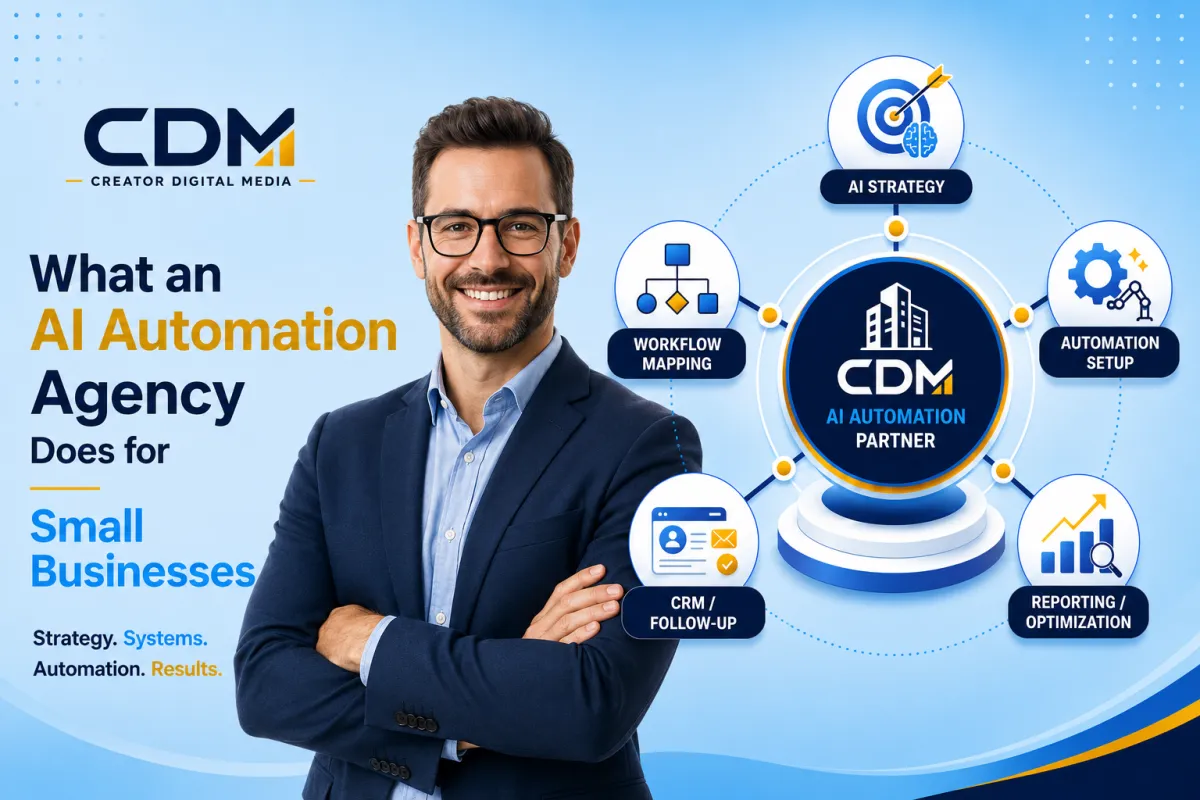
What an AI Automation Agency Does for Small Businesses
Small businesses are being told to use AI, automate more, and modernize their operations. That advice is easy to give. The harder part is knowing what to do first, how to set it up, and how to make sure the business gets a real result.
That is where an AI automation agency can help.
An AI automation agency helps a business identify where AI and automation fit, map the workflows that need improvement, select or connect the right tools, build the automation logic, and support implementation so the business can operate with better speed, consistency, and visibility.
The work is not just about adding AI software. It is about improving how the business runs.
AI automation should start with business operations
Many small businesses start by asking which AI tool they should buy. That is understandable, but it is usually not the best starting point.
An AI automation agency should first help the business understand what is happening operationally. Where are leads missing? Where is follow-up inconsistent? Where does the owner spend too much time on manual admin? Where do customers wait too long for a response? Where is information hard to find?
The goal is to connect AI to real business problems.
For a small business, useful automation often starts with areas like lead handling, missed-call follow-up, appointment scheduling, customer intake, CRM updates, reporting summaries, proposal preparation, or internal task reminders.
These are not abstract AI projects. They are business workflows that can be improved.
What an AI automation agency typically does
An effective AI automation agency usually supports several parts of the process.
1. Clarifies the business goal
Before building anything, the agency should help define the outcome. The goal may be faster lead response, fewer missed follow-ups, better customer intake, cleaner CRM data, more consistent reporting, or less manual work for the owner.
This matters because automation without a clear goal can become another layer of complexity. A business should know what result it wants before adding tools or workflows.
2. Maps the current workflow
A good agency will look at how work happens today. That may include forms, calls, calendars, emails, CRM records, team handoffs, follow-up steps, and customer communication.
This workflow mapping step helps reveal where the friction is. It also prevents the business from automating a broken or unclear process.
The agency should be asking focused operational questions:
· What triggers the workflow?
· What information is needed?
· Who owns the next step?
· Where does the process slow down?
· What should happen automatically?
· Where does a human need to review?
These questions keep the project grounded.
3. Recommends the right automation path
Not every business needs a complex AI system. Sometimes the right answer is a simple workflow automation. Sometimes it is a CRM update. Sometimes it is an AI chat assistant, a voice AI workflow, an internal knowledge tool, or a reporting summary.
The agency should help determine what level of automation fits the business.
The best solution is not always the newest tool. It is the solution that fits the workflow, integrates with the existing systems, and can be maintained by the business.
4. Builds and connects the systems
Once the workflow is clear, the agency can help build the automation. This may involve connecting forms, CRM pipelines, tags, calendars, email or SMS follow-up, AI prompts, internal notifications, task creation, reporting, and customer-facing tools.
For many small businesses, the value comes from making disconnected steps work together. A lead submits a form. The CRM is updated. A notification is sent. A follow-up task is created. A confirmation message goes out. The owner can see what happened.
That type of connected workflow can reduce missed opportunities and make the business more consistent.
5. Adds AI where it actually helps
AI should not be forced into every workflow. It should be used where it improves speed, quality, consistency, or decision support.
Examples include:
· Drafting follow-up messages
· Summarizing intake responses
· Answering common questions
· Routing inquiries
· Preparing proposal notes
· Summarizing activity reports
· Supporting customer service triage
· Helping staff find internal information
The agency should also define where human review is required. AI can support the workflow, but the business still needs control over customer-facing quality, sensitive information, and final decisions.
6. Tests the workflow before expanding
A useful automation should be tested before it is treated as permanent. The agency should help the business check whether the workflow works as expected, whether messages are accurate, whether tasks are created correctly, and whether the handoffs make sense.
Testing also helps identify edge cases. What happens if a lead gives incomplete information? What happens if a customer asks something outside the normal scope? What happens if a staff member needs to override the automation?
Small businesses do not need to overcomplicate testing, but they should not skip it.
7. Measures whether the work improved the business
Automation should be measured against the business goal. Otherwise, it becomes difficult to know whether the project was worth it.
Useful measures may include:
· Faster lead response time
· Fewer missed calls or missed follow-ups
· More completed appointments
· Less manual admin time
· Cleaner CRM records
· Better visibility into open opportunities
· More consistent customer communication
· Fewer repeated internal tasks
The agency should help the business understand what changed and whether the workflow should be improved, expanded, or left alone.
What an AI automation agency is not
An AI automation agency should not just sell tools. It should not simply install software and leave the business to figure out adoption. It should not recommend automation before understanding the workflow.
The value should come from effective implementation tied to business outcomes.
A good agency helps translate business needs into working systems. It connects strategy, workflows, tools, ownership, and measurement.
Why this matters for small businesses
Small businesses do not always have internal operations teams, automation specialists, or technical staff. The owner may be handling sales, service delivery, customer communication, follow-up, reporting, and admin at the same time.
That makes well-designed automation valuable.
The right system can help the business respond faster, follow up more consistently, reduce manual work, and make daily operations easier to manage. It can also help the owner see what is happening without digging through disconnected tools.
The best agency partnerships prioritize ROI over hype
The best AI automation agency relationship is not about making the business feel more advanced. It is about helping the business run better.
That means starting with one clear workflow, building a focused solution, testing it, measuring it, and improving from there.
For many small businesses, the first win does not need to be large. It needs to be real.
Final thought
An AI automation agency helps small businesses move from scattered AI experiments to working business systems. The right agency should help clarify where AI fits, improve specific workflows, connect the right tools, and make sure the business can measure what changed.
Creator Digital Media helps small businesses map AI and automation to real operating needs. If your business is ready to explore automation, the next step is to identify the workflow that should be improved first
Ready to identify where AI or automation could improve your business operations?