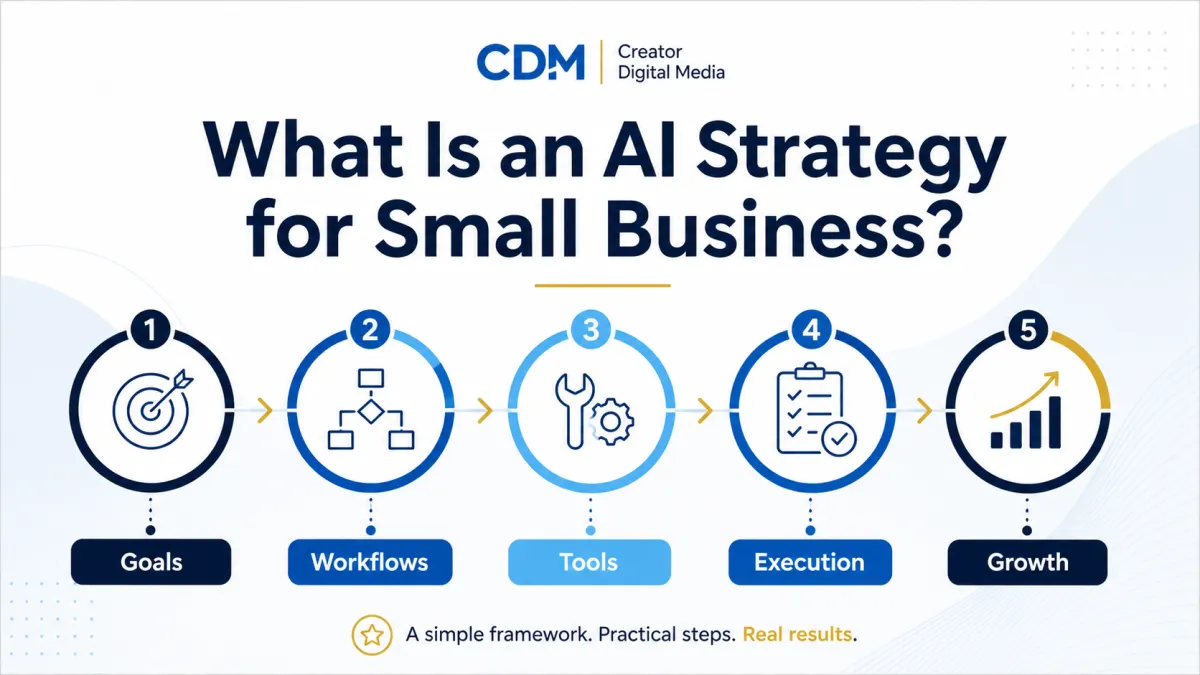
What Is an AI Strategy for Small Business?
Artificial intelligence is becoming easier to access, but that does not mean small businesses are getting better results from it. Many owners are trying tools before they have a clear plan. That usually creates more accounts, more experiments, and more confusion.
An AI strategy gives the business a way to decide where AI fits, what problem it should solve first, who owns the work, and how success will be measured. It does not need to be a long enterprise document. For a small business, it should be a clear operating plan that connects AI use to business goals, workflows, people, tools, data, and growth.
A simple definition: an AI strategy is a plan for using AI to improve specific business outcomes without adding unnecessary complexity.
That definition matters because AI should not be treated as a novelty layer on top of the business. It should support the way the business actually operates. For a service business, that may mean improving lead response, appointment booking, customer intake, follow-up, reporting, or internal knowledge access. For an owner-led company, it may mean reducing manual work so the founder can spend more time on sales, customer experience, or delivery quality.
Why strategy should come before tools
The fastest way to waste time with AI is to start with the tool instead of the workflow. A tool-first approach usually sounds like this: a new AI product looks interesting, someone creates an account, the team tests it for a few days, then no one knows whether it made the business better.
A strategy-first approach starts with a different set of questions:
1. What business outcome are we trying to improve?
2. Which workflow is slow, inconsistent, or too dependent on manual effort?
3. What information does the AI system need to do the job well?
4. Who reviews the output?
5. How will we measure whether the change worked?
Those questions keep AI tied to execution. They also help a business avoid tool sprawl, weak adoption, and unclear ownership.
The core parts of an AI strategy
A small business AI strategy does not need to be complicated. It should cover five operating areas.
Goals: Start with the business result. Do you want faster lead response, fewer missed follow-ups, better customer intake, stronger reporting, lower admin time, or more consistent content production?
Processes: Identify the workflow before selecting the tool. AI works best when it is mapped to a repeatable process with clear inputs, outputs, and handoffs.
Tools: Choose tools after the workflow is defined. The right tool depends on the job, the integration requirements, the data involved, and the level of oversight needed.
Execution: Decide how the workflow will be tested, who owns it, what the review process looks like, and what happens when the system is wrong or incomplete.
Growth: Measure the result. Look for time saved, faster response, better conversion, fewer errors, improved visibility, or more consistent customer experience.
Where a small business should start
Most small businesses should not begin with a large AI transformation. They should begin with one business bottleneck that is frequent, measurable, and meaningful.
Good starting points include:
Lead intake and response
Appointment scheduling
Missed-call follow-up
Customer FAQ handling
Proposal or quote preparation
Internal reporting
Content repurposing
CRM updates and task reminders
The best first use case is usually one where the business already understands the workflow but needs more speed, consistency, or visibility. Starting there keeps the project grounded.
What an AI strategy is not
An AI strategy is not a list of tools. It is not a generic statement that the business wants to use AI. It is not a one-time brainstorming session. It is not an instruction to automate everything.
A useful AI strategy should make decisions easier. It should help the owner know what to do first, what to avoid, what needs human review, and what should be measured before expanding.
The risk of moving without a strategy
Without a strategy, AI adoption can create operational noise. Teams may use different tools for similar tasks. Customer-facing outputs may become inconsistent. Sensitive information may be handled without clear rules. Owners may spend money on software without knowing whether it is improving the business.
The bigger risk is not that AI fails completely. The bigger risk is that it gets used in scattered ways that never turn into a business capability.
A better path for SMBs
The better path is simple: define the business goal, map the workflow, choose the right tool, test with clear ownership, then measure what changed.
That is the foundation of a small business AI strategy. It gives the business a way to move faster without losing control. It also helps owners separate useful AI adoption from random experimentation.
Creator Digital Media helps small businesses clarify where AI fits, identify the right starting point, and build automation workflows that support real operating needs. If your business is considering AI but does not yet have a clear roadmap, the next step is to map the strategy before adding more tools.
Ready to identify where AI or automation could improve your business operations?