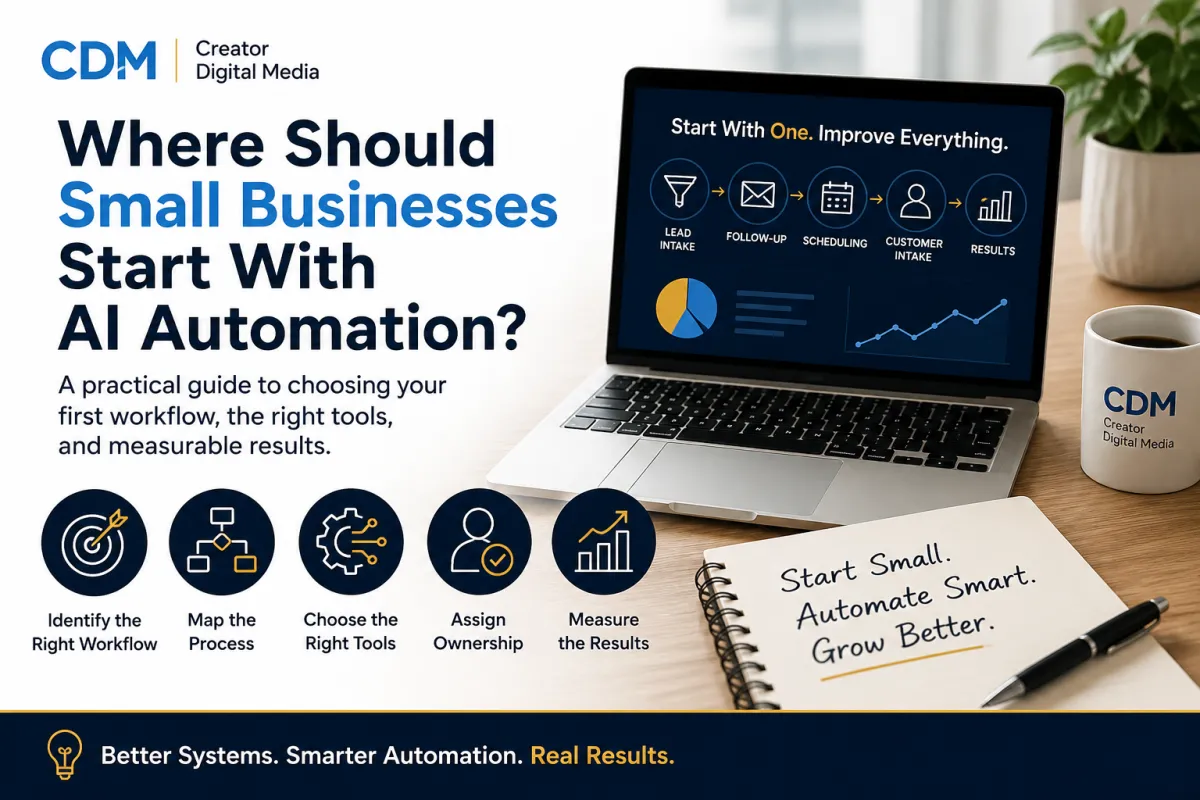
Where Should Small Businesses Start With AI Automation?
Small businesses are hearing a lot about AI automation, but many owners still face the same practical question: where should we actually start?
The answer is not to automate everything. It is not to buy the most advanced tool. It is not to copy what a larger company is doing.
The right starting point is one repeated workflow that is important enough to matter, simple enough to test, and clear enough to measure.
For most small businesses, AI automation should begin with a business bottleneck. That bottleneck may be slow lead follow-up, missed calls, manual customer intake, repetitive email replies, inconsistent content production, reporting gaps, or tasks that depend too heavily on the owner.
The goal is not to use AI for the sake of using AI. The goal is to remove friction from the way the business already operates.
Start with the workflow, not the tool
Many businesses start AI adoption by asking, “Which AI tool should we use?”
That is usually the wrong first question.
A better question is: “Which workflow is slowing the business down or creating avoidable inconsistency?”
Tools should come after the workflow is understood. If the workflow is unclear, automation will usually make the confusion faster. It may create more notifications, more disconnected systems, and more manual cleanup.
Before choosing a tool, the business should define:
What task or process is being improved
Who owns the workflow today
What information goes into the process
What output should be created
Where human review is still needed
How success will be measured
This keeps AI automation tied to business execution instead of random experimentation.
Good first automation areas for small businesses
The best first automation use case is usually a repeated task with clear rules and visible business impact.
For many small businesses, good starting points include:
1. Lead intake and response
Lead response is one of the strongest places to start because speed and consistency matter. If a potential customer fills out a form, sends a message, or calls the business, delay can cost revenue.
AI and automation can help route the lead, send an initial response, collect missing information, notify the right person, and trigger follow-up reminders.
This does not mean every lead should be handled entirely by AI. It means the business should reduce the chance that a lead is missed, forgotten, or delayed.
2. Missed-call follow-up
Many service businesses lose opportunities when calls are missed. A simple automation can send a follow-up text, ask what the person needs, collect basic details, and route the inquiry to the right next step.
This is a practical starting point because the workflow is easy to understand. A call was missed. A response needs to happen quickly. The business needs visibility into whether follow-up occurred.
3. Appointment scheduling and confirmations
Appointment-based businesses often spend too much time coordinating schedules, confirming details, and sending reminders.
Automation can help with booking links, confirmations, reminders, no-show follow-up, and internal notifications. AI can also help summarize intake details before the appointment so the business is better prepared.
This type of automation supports both efficiency and customer experience.
4. Customer intake
Customer intake is often repetitive. The business needs the same basic information before it can provide a quote, schedule service, complete onboarding, or prepare for a consultation.
AI automation can help collect that information, organize it, summarize it, and place it into the right system. This reduces manual back-and-forth and gives the business cleaner information before the next step.
5. Follow-up reminders
Follow-up is one of the easiest places for opportunities to leak. A prospect may need a reminder. A customer may need a check-in. A task may need to be completed after a call.
Automation can help create reminders, assign tasks, send follow-up messages, and keep the pipeline moving. The value is not just saving time. The value is making sure important actions do not depend only on memory.
6. Reporting and visibility
Many small businesses do not need complex dashboards first. They need simple visibility.
Examples include new leads received, calls missed, appointments booked, proposals sent, follow-ups completed, and open opportunities. AI can also help summarize activity so the owner can quickly understand what happened and what needs attention.
Better reporting helps the business make decisions with less guesswork.
How to choose the first automation
A small business should choose the first AI automation based on four criteria.
Frequency
Does the task happen often enough to matter?
A workflow that happens every day or every week is usually a better starting point than something rare. Repeated workflows create more value because every improvement compounds over time.
Friction
Is the task slow, inconsistent, or dependent on one person?
Good automation candidates often involve delays, manual copy-and-paste work, forgotten follow-ups, repeated questions, or handoffs that fall through the cracks.
Business impact
Would improving this workflow affect revenue, customer experience, delivery quality, or owner time?
The first automation should connect to a real business outcome. If the automation saves time but does not improve anything meaningful, it may not be worth prioritizing yet.
Measurability
Can the business tell whether the automation worked?
This matters. A first automation should have a simple success measure, such as faster response time, fewer missed leads, fewer manual steps, more completed follow-ups, or less time spent on repetitive admin work.
What to avoid first
Not every process should be automated first.
Small businesses should usually avoid starting with workflows that are highly complex, poorly documented, legally sensitive, financially risky, or heavily dependent on judgment.
They should also avoid automating a broken process before clarifying how it should work. AI automation is most useful when it improves a defined workflow. It is less useful when the business has not decided what the workflow should be.
A good rule is simple: do not automate confusion.
The best first automation is small but meaningful
A strong first AI automation does not need to be impressive. It needs to be useful.
For a small business, a practical first automation may look like:
A missed-call follow-up workflow
A lead intake workflow
A customer FAQ triage workflow
A proposal preparation workflow
A task reminder workflow
A weekly reporting summary
A content repurposing workflow
The common pattern is that each one supports a repeated business activity. Each one can be tested. Each one can be improved over time.
The owner still needs control
AI automation should not remove ownership. It should make ownership clearer.
Every automation should have a person responsible for reviewing performance, correcting issues, and deciding when the workflow should expand. This is especially important when the automation affects customers, leads, sales, or sensitive information.
A small business does not need enterprise-level governance to begin. But it does need clear rules.
At minimum, the business should define:
Who owns the automation
What the automation is allowed to do
When a human must review or intervene
What information should not be used
How results will be checked
That level of clarity helps the business move faster without losing control.
A practical starting framework
The simplest way to start is this:
Pick one repeated workflow
Define the business outcome
Map the current process
Identify the manual steps
Choose the right tool or automation path
Assign an owner
Test for 30 days
Measure what changed
This approach keeps the project grounded. It also helps the business avoid tool-chasing.
Final thought
Small businesses should start AI automation where it can create clear operational value. That usually means one repeated workflow, one measurable business goal, and one person responsible for making sure it works.
The first automation should not be the biggest idea. It should be the clearest starting point.
Creator Digital Media helps small businesses identify where AI automation fits, choose the right first workflow, and build systems that support real business operations. If your business is ready to explore AI automation, the next step is to map the workflow before adding more tools.
Ready to identify where AI or automation could improve your business operations?